


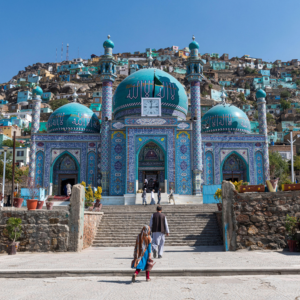
16-year-old Sara from the Afghanistan Newsroom explains how the Taliban are forcing change on the country’s religious minorities
The Taliban is attempting to force religious minorities in Afghanistan to change their religious belief system and follow the Sunni Muslim majority in the country.
Earlier this year, the Taliban imposed a compulsory pledge for university students to sign. The pledge contains 14 articles. These include rules on dress codes and attending classes on time, but many are extreme and limit personal freedom; for example, they forbid listening to music or taking photographs.
Article 6 in particular stands out. It states, “As citizens of Afghanistan are followers of the Sunni sect, according to rules, I will also follow the mentioned sect.” This refers specifically to the Hanafi school of jurisprudence that most Sunni Muslims follow.
Harbingers’ Weekly Brief
Subscribe to the Harbingers’ Weekly Brief, a newsletter written by the editorial board of Harbingers’ Magazine, the world’s youngest newsroom, delivered to your inbox every Monday morning.
![author_bio]()
![author_bio]()


It gets even worse as the students were given an ultimatum between signing the pledge and dropping out of the university. It faced immediate backlash from figures within the Shia community, who succeeded in convincing the authorities to drop the article – at Kabul University, at least.
I had the chance to talk to one of the affected students. He attended Kabul University and talked about his first-hand experience with the pledge. He explained that they read the pledge and complained that they are from different sects and cannot follow Sunni practices, but the authorities told them they could either sign the agreement or drop out of the university.
He said, “It put us in a very hard situation. We care about our religion, but our education is also important, so we were not sure what to do.”
This is not a one-time event, but a series of systematic actions aiming to erase minority identities. The university pledge was changed, but the damage was already done; it attracted attention to what is really going on.

However, the situation has created concerns about the fairness and trustworthiness of the Taliban government.
Afghanistan has always been a diverse country, home to people from different ethnicities, religionsand beliefs. The vast majority of citizens are Muslim, but there are also small Sikh, Hindu and Jewish communities. Most Afghanistani Muslims follow the Sunnibranch of Islam, but 10–15% are followers of Shia, and there are other smaller sects (although it is hard to find reliable data).
Although the Taliban have always claimed to respect all followers of Islam from any sect since their return to power, the evidence suggests otherwise.
The Taliban minister for rural rehabilitation and development said that the Taliban respectfollowers of all Islamic sects. However, the Taliban minister of higher education has also statedthat “All Afghans follow the Hanafi school of thought,” directly denying the existence of any other Islamic sect or religion in the country.
In early 2026, the Taliban clerics’ council in Badakhshan tried to bribe Ismaili Muslims (a branch of the Shia sect) to convert to the Sunni sect. They promised financial rewards, security guarantees and government jobs for those who converted.
Some sources even claim that the citizens were being forced through threats. UNAMA (United Nations Assistance Mission in Afghanistan) reported that 50 Ismaili men in Badakhshan were forced to convert between January and February by physical punishment and threats of death.
View this post on Instagram
This is evidence that the Taliban are not only trying to make people follow the Hanafi belief system, but they are also trying to get rid of other sects by deleting relevant education.
In 2025, it was reported that the authorities in Bamyan province in central Afghanistan have ordered schools to only teach Hanafi jurisprudence, and to remove Jafari jurisprudence from the education system.
This is significant because Bamyan is a Shia-majority province, and by removing Jafari sect-related education, they are actively banning children from learning about their religion.
While the Taliban talk of fairness and equality for everyone, their own words and actions defy their claims. Past events create concerns for the future. Are the Taliban going to keep pressuring religious minorities until the day they disappear?

Edited by:

© 2026 The Oxford School for the Future