Harbingers’ Magazine is a weekly online current affairs magazine written and edited by teenagers worldwide.
harbinger | noun
har·bin·ger | \ˈhär-bən-jər\
1. one that initiates a major change: a person or thing that originates or helps open up a new activity, method, or technology; pioneer.
2. something that foreshadows a future event : something that gives an anticipatory sign of what is to come.
We and our partners may store and access personal data such as cookies, device identifiers or other similar technologies on your device and process such data to personalise content and ads, provide social media features and analyse our traffic.
Imagine this: you’re driving down a quiet bumpy road desperately scanning the bushes for any form of life.
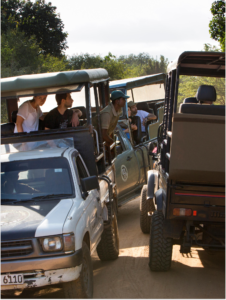
The only creature you’ve spotted for the past two hours was an iguana – the same kind that lives in almost every Sri Lankan backyard – and then you see it: about 20 safari jeeps jammed into a narrow dirt road.
Why on earth is there a traffic jam in the middle of the jungle, you think. The answer is simple: a leopard crossed the road about 15 minutes ago.
The first time I visited the park, I was just a few months old. Thanks to my family’s passion for wildlife, I’ve been a frequent visitor ever since, so I’ve witnessed the park’s evolution – and its slow downfall over the past few years.
Located in southeastern Sri Lanka, a few hours’ drive from Colombo and Galle, Yala is Sri Lanka’s most popular national park, with more than 770,000 visitors in 2025. Covering about 980 square kilometres, it has a wide variety of habitats, including dry forests, grasslands, wetlands, lagoons and coastline. It’s home to 44 mammal species, 215 bird species, 47 reptile species and – a key pull for tourists – has the highest density of leopards in the world.
Harbingers’ Weekly Brief
Subscribe to the Harbingers’ Weekly Brief, a newsletter written by the editorial board of Harbingers’ Magazine, the world’s youngest newsroom, delivered to your inbox every Monday morning.
See you on Monday!
Ooops - please try again.
The park is divided into five blocks plus an area that’s inaccessible to the public. Blocks I – the most popular due to its high density of animals – and V are open to the public; the other blocks require special permission to be entered.
Visitors can use licensed safari jeeps or private vehicles approved by the authorities with a licensed guide. Drivers can be charged with fines and temporary bans from the park for breaking rules. The park has patrol vehicles to monitor visitors’ behaviour.
Fewer animals
Several years ago, a herd of about 20 elephants was not a rare sight in Yala, and you’d see so many deer and wild boar that you’d think they covered every inch of the jungle. In the evening, you might even encounter a sloth bear or a leopard crossing the road.
Now, the largest recorded herd consists of 25 individuals, but the average herd consists of only three to four elephants. The high mortality rate of young calves due to malnutrition may be a contributing factor
While there is no evidence showing that other mammal populations have decreased recently, I’ve noticed that the probability of spotting animals is increasingly difficult. In fact, you see more jeeps than any other creature.
During the tourist season from February to July, Block 1 alone sees about 500 jeeps a day. This mostly affects the leopards, the park’s most popular yet most elusive animal. When a safari jeep spots a leopard, its driver usually shares the news with nearby jeeps, so they can entertain their visitors as well. This leads to overcrowding and road blockages.
In their haste, some drivers exceed the speed limit and on rare occasions hit small animals. Some drivers harass the leopard by getting too close or blocking its path – just so that their passengers can get a better look.
All this causes stress to surrounding wildlife. Overtourism also leads to littering, noise pollution and damage to native flora as many visitors fail to do research on the rules and regulations of the park.
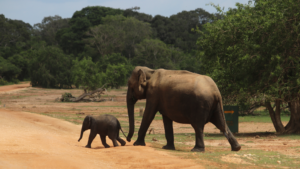
A mother elephant and her calf cross a road in Yala National Park.
Sometimes, jeeps also harass tuskers (male elephants with tusks) in musth,a period that leads to heightened aggressive behaviour. Tuskers are extremely popular and for some people, intentionally provokingan elephant to chase them is a thrilling experience. This is extremely dangerous as it puts the lives of the visitors and the well-being of the elephants at risk. It’s best to observe elephants in musth from afar.
The overcrowding and subsequent lack of monitoring leads to many rules being broken – such as allowing passengers to climb out of the vehicle inside the park in order to feed the animals.
Yala’s famous tusker Gemunu loves to begfor food from jeeps. Beloved as he is, he could seriously injure a visitor due to his lack of fear when approaching humans. The park’s toque macaques,an endemic species of monkey, are also notorious for stealing food from tourists, and this can get extremely dangerous if you meet a particularly brave and daring monkey.
Drivers also tend to speed towards the entrance gates before the park closes in order to avoid being fined or banned, again putting passengers and wildlife at risk.
Illegal electric fences
The dry season in Yala and the surrounding area is absolutely brutal. It leaves little to no food for animals and a few muddy puddles of water.
Elephants tend to remain inside the park in the rainy season where there is food in the open fields, but during the dry season they rely on the plants growing in the nutrient-rich soil of abandoned chena cultivations outside the park.
Chena cultivations are a traditional method of agriculture that involves burning a small area to create a nutrient-rich soil. After harvesting, the land is left to be reclaimed by the forest.
Due to the increasing conflict over land and resources among humans and elephants, people have erected electric fences between the park and the cultivated areas. Some of these fences are illegal and privately owned, often conducting voltages that are fatal to elephants. These make it difficult for elephants to travel outside the park to access food and water.
In Yala National Park, 54%of elephant calves die of malnutrition before they reach the age of two. Their mothers lack the nutrients to produce enough milk to sustain their offspring, and they cannot break through the electric fences with young calves in tow.
This has had a devastating impact on many herds, with their populations slowly dwindling. The last time I saw a large herd was in 2023: 15 elephants sandbathing near the main road. Little did I know what a rare sight it would become.
It’s also important to note that the Department of Wildlife Conservation, the government sector in charge of the country’s national parks and wildlife, is facing increasing pressure from local communities as the human–elephant conflict puts human lives at risk, meaning solutions are needed fast.
What you can do to help
Have you ever thought of visiting Yala National Park? If you want to be a responsible tourist, there are several things to bear in mind.
Do your research before booking a tour. Make sure your jeep driver is ethical and responsible; an ethical driver should keep their distance from animals, especially mothers with their babies. Always let them know exactly what experience you’re looking for.
Inform yourself of the park’s rules and regulations, and respect them. Stick to these rules even if your driver tells you that it’s fine.
Most importantly, remember, Yala isn’t your only option: Sri Lanka is home to 26 national parks. Instead of choosing the most trending tourist location on social media, consider broadening your horizons. Plenty of national parks and the local communities that surround them can greatly benefit from tourism, helping to aid the conservation of these beautiful places.
Hesandi Ravisinghe, born in 2009 in Galle, Sri Lanka, joined Harbingers’ Magazine as a contributor to the Sri Lankan Newsroom in January 2024. After completing the writing course, she became a regular writer, focusing on wildlife and science.
Her strong interest in nature and consistent work with the magazine led to her appointment as Science Section Editor in March 2025, a role she continues to hold in 2026. She also serves as Editor of the Nepali Newsroom.
Hesandi has a deep interest in art, nature and wildlife, particularly elephants, leopards and birds.
In her free time, she enjoys painting and travelling.
Hesandi speaks English and Sinhala and is currently learning Indonesian.
🌍 Join the World's Youngest Newsroom—Create a Free Account
Sign up to save your favourite articles, get personalised recommendations, and stay informed about stories that Gen Z worldwide actually care about. Plus, subscribe to our newsletter for the latest stories delivered straight to your inbox. 📲
We use cookies to ensure that we give you the best experience on our website. If you continue to use this site we will assume that you are happy with it.