


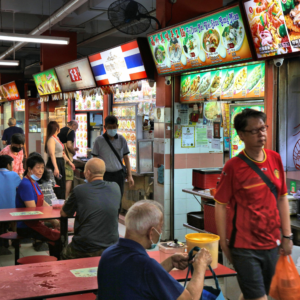
17-year-old Atharva examines how the island-state is trying to reduce the amount of food it throws away
Singapore has never had the luxury of wasting space or resources. Some 6.21 million people live on an island roughly the size of New York City, making it one of the most densely populated countries in the world. With little farmland, limited natural freshwater and almost no room for conventional expansion, the city-state purifies seawater, reclaims land from the sea and imports more than 90% of its food.
Given all that, it is striking that Singapore throws away around 790,000 tonnes of food a year, one of its largest waste streams, of which just 18% is recycled – according to the National Environmental Agency (NEA).
This is both an environmental failure and an economic one due to it being the product of the structural incentives that make wasting food the rational choice.
Harbingers’ Weekly Brief
Subscribe to the Harbingers’ Weekly Brief, a newsletter written by the editorial board of Harbingers’ Magazine, the world’s youngest newsroom, delivered to your inbox every Monday morning.
![slide image]()
![author_bio]()
![author_bio]()


Why consumers overbuy
One of the reasons for this is people’s optimistic estimation of the amounts of food they will be able to consume – a cognitive mistake known as optimism bias. You buy vegetables on Sunday, with every intention of cooking them. By Thursday, you have to throw them out. Singaporeans are no exception: in an NEA survey, one in four admitted to buying more food than they actually needed.
Another factor is that you don’t feel the pain of the expense after you’ve spent the money. For instance, by the time the spinach turns limp, it is too late to actually regret it – the money already spent no longer feels like a loss.
Furthermore, median income in Singapore has increased considerably over the last two decades, so food is now a smaller share of household budgets, further reducing the perceived cost of waste.
View this post on Instagram
Role of supermarkets
While consumers are often faulted for wastage of food in the food industry, the supply chain should also be looked into. Commercial and industrial premises such as supermarkets, hotels and food manufacturers account for about 40% of the food Singapore wastes each year.
Supermarkets often apply strict cosmetic standards to produce, judging it by size, shape and even colour, which means that perfectly edible food is discarded before it ever reaches the shelf. Since Singapore imports most of its produce, much of that culling happens overseas rather than here.
Restaurants are also culpable as they tend to serve more than they should, just to show how much they are worth in the competitive restaurant environment. For Singaporeans, eating everything that you ordered in a restaurant has become the norm.
Where the waste ends up
The scale of Singapore’s food waste problem can be better realised downstream in the food cycle.
The country recycles just 18% of all the food waste generated per year. Moreover, the cause of this is mainly structural as most food scraps are usually mixed with general rubbish, so instead of being composted or digested they are simply burned.
Additionally, the requirement to separate food waste from general rubbish only reached large new commercial buildings in March 2024, and won’t extend to existing ones until 2027.
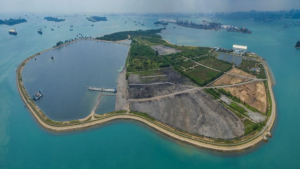
Most waste goes to an incineration plant where the resulting ash is taken and shipped to Semakau Landfill, Singapore’s only landfill, which the NEA expects to reach capacity by 2035. In such a small country with almost no land left to spare, every additional tonne of food waste brings that deadline closer.
Food waste is also a waste of the water, energy and effort that was spent producing it. Although, beyond these costs, the most prominent seems to be the environmental bill of burning it.
In 2023, the 623,000 tonnes of food waste disposed of carried an estimated environmental costof around 2.4 million Singapore dollars ($1.8m). That's enough to feed roughly 167 families for a year.
Additionally, the Covid-19 pandemic and Malaysia’s 2022 ban on chicken exports, which suddenly cut off about a third of Singapore’s chicken supply, have shown that relying on the world market for almost everything is far from safe.
Government action
The government’s Zero Waste Masterplan (2019) has set out plans to reduce the amount of waste going to landfill, and mandatory segregation of food waste has been introduced for large commercial and industrial facilities. It is also investing in new infrastructure such as Tuas Nexus, a S$1.5bn integrated facility that will treat food waste and recover energy from it, which is due to come online from 2027.

Meanwhile, Singapore has scaled back its ambitions to grow more of its own food. In November 2025, the government replacedits “30 by 30” goals of producing 30% of the national nutritional needs locally by 2030 with narrower targets: 20% of vegetables and 30% of eggs and seafood by 2035. In 2024, local farms supplied just 8% of the former. With homegrown supply this limited, every tonne of imported food that ends up in the bin matters even more.
However, critics say these steps only tackle the symptoms rather than the root problem. Too much of the Zero Waste Masterplan currently focuses on educating the public and relying on voluntary commitments, which mainly reach those who were already worried about waste.
Furthermore, with Semakau Island nearing capacity and no comprehensive food waste treatment in place until 2027, the window for gentle nudges is closing fast.
A local example
Singapore-based social enterprise GreenNudge sees sustainability as an integral part of daily routine and not something extra. Its motto is ‘Making Green the Norm’ – in other words, changing habits so that people stop automatically throwing things away.
A member of the GreenNudge team explained that meaningful change often begins with small, achievable wins over sweeping change. For example, the most effective way to cut waste in a setting like a hawker centre (Singapore’s unique version of the food court) is to start with something manageable such as capturing raw waste such as coffee grounds rather than cooked leftovers, which are harder to process and tend to clog up collection bins.
Just as important is how the message is delivered. They argued that sustainability is too often communicated in a corporate, top-down manner, when encouragement through inspiration and hope rather than instruction, can be more effective in building lasting habits.

Edited by:

© 2026 The Oxford School for the Future