


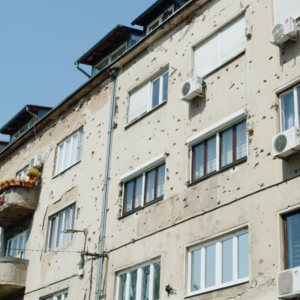
17-year-old Nell shares her first-hand impressions of the city and its troubled recent history
Holes in buildings, gaping wounds in concrete and damaged statues are jarring sights, but for the people of Sarajevo they are also part of their everyday landscape. More than 30 years after the Bosnian War (1992–95), reminders of the conflict are still visible across the city.
Yugoslavia began to collapse in the early 1990s amid an economic crisis and rising ethnonationalism, culminating in the outbreak of war in 1992. The Siege of Sarajevo began on 5 April 1992 and lasted until February 1996 – 1,425 days in all. The city was surrounded by Bosnian Serb forces, initially supported by the Yugoslav People’s Army.
Residents were cut off from basic necessities such as electricity, running water, heating and a reliable food supply. More than 500,000 bombs were dropped on the city, with civilians subjected to an average of 329 mortar attacks a day. Some of the most notorious areas were along “Sniper Alley”, where civilians crossing exposed streets risked being shot.
More than 11,000 people were killed, 50,00 were injured and 60% of the city’s buildings were destroyed or badly damaged. Much of Sarajevo has since been rebuilt, but many residential buildings still carry visible traces of the siege.
View this post on Instagram
Sarajevo as a living memorial
Sarajevo, now the capital of Bosnia and Herzegovina, has long been shaped by the empires and political systems that have ruled it. Walking through the city, you pass narrow cobbled streets and mosques dating from the Ottoman period, European revival-style buildings from the Austro-Hungarian period, and the modernist and brutalist architecture associated with the Socialist state of Yugoslavia.
The damage left by the war has become another layer of that history.
For an outsider, it can be tempting to look at damaged walls and bullet holes and wonder why they have not simply been repaired. But some of these marks are also reminders of the people who were killed, and of what the city survived.
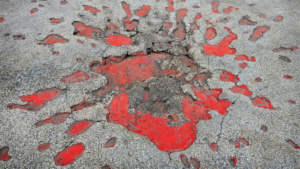
Some traces have been deliberately preserved as memorials. They are built into the streets and pavements of the city, making the memory of the war part of daily life. A number of craters left by mortar shells were filled with red resin. Known as the Sarajevo Roses, they mark places where people were killed during the siege.
Unsettled scores
There is also another reason why the physical traces of war still matter: questions of justice and responsibility remain sensitive.
Between 1993 and 2017, the International Criminal Tribunal for the former Yugoslavia indicted 161 people for serious violations of international humanitarian law, of whom 93 were sentenced. Trials were also held in Bosnia and Herzegovina and other countries. But the legal cases did not end arguments about responsibility for the war, or about the failures of the international community.
Walking through Sarajevo, I repeatedly came across anger about the role of the United Nations. During the war, the UN provided humanitarian aid, worked on diplomatic negotiations and deployed the United Nations Protection Force (UNPROFOR).
One of the biggest sources of criticism is the genocide at Srebrenica in July 1995. Srebrenica had been declared a UN “safe area”, yet UN forces failed to prevent Bosnian Serb forces from taking the town. More than 8,000 Bosnian Muslim (Bosniak) men and boys were subsequently killed.
UN forces were also unable to stop the shelling and sniper attacks on Sarajevo, partly because of the limits of their mandate and capabilities. Humanitarian aid was essential to civilians during the siege, but there were also complaints about its quality, including expired food and inadequate rations.
The role of international institutions in Bosnia did not end with the war. After the Dayton Peace Agreementwas signed in 1995, the position of High Representative for Bosnia and Herzegovina was created to oversee the civilian implementation of the agreement.
The High Representativehas wide powers, including the ability to impose certain decisions and remove public officials who are found to be violating the peace agreement or their legal obligations.
The system was created after a devastating war, but 30 years later it continues to raise questions about how much authority international institutions should still have in Bosnia and Herzegovina.
In this context, the scars left on Sarajevo’s buildings are not only reminders of what happened during the war. They also sit alongside unresolved arguments about responsibility, justice and the role of outside powers.
Bureaucracy and money
There is also a simpler reason why some buildings remain damaged: rebuilding is expensive and complicated. Fragmented ownership, limited public funding and disagreements over responsibility can all make repairs difficult.
This means that not every bullet hole or damaged facade has been deliberately preserved. Some marks remain because they have become memorials, but others remain because restoration has not happened.
Harbingers’ Weekly Brief
Subscribe to the Harbingers’ Weekly Brief, a newsletter written by the editorial board of Harbingers’ Magazine, the world’s youngest newsroom, delivered to your inbox every Monday morning.
![author_bio]()


That leaves Sarajevo with a cityscape where memory, politics and the practical problems of rebuilding are difficult to separate.
More than three decades after the siege, the question is not only whether the remaining damage should be repaired, but also which traces should be preserved, who should decide, and who should pay for what is left.

© 2026 The Oxford School for the Future