



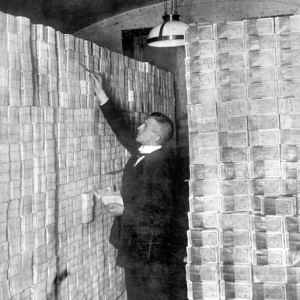
17-year-old Max looks back at Germany’s 1923 hyperinflation crisis
In 1923, Germany experienced one of the worst cases of hyperinflation in modern history. The German mark lost its value so quickly that workers rushed to spend their wages before prices rose again.
This article explains what caused this crisis, how it affected ordinary people, and how Germany finally brought it to an end.
What was the Weimar Republic?
The Weimar Republic was Germany’s first parliamentary democracy. It emerged in 1919 after the collapse of the German Empire and Germany’s defeat in the First World War.
Named after the market town of Weimar where the republic’s constitution was drafted, it was one of the most democratic systems of its time. It included progressive ideas such as legal equality, voting rights for all and civil liberties.
Despite these ideals, the republic was heavily undermined by political and economic instability.
View this post on Instagram
Why was Germany economically fragile?
When the Weimar Republic was established, it did not start on stable ground. Germany faced mountains of war debt, political unrest, shortages and the economic demands of the Treaty of Versailles.
This treaty, which officially ended the war between Germany and the Allied powers, forced Germany to pay reparations. Germany also lost territory, colonies and access to some valuable economic resources.
The government already owed large amounts of money because it had borrowed heavily to pay for the war. Instead of raising most of the money through taxes, the wartime government had expected Germany to win and make its defeated enemies pay.
Germany’s new democratic system was also politically divided. Coalition governments were often fragile, while uprisings, attempted coups and political violence made it harder to respond to economic crises. This enabled extremist parties to gain traction, which only further contributed to the instability within the Weimar Republic.
Harbingers’ Weekly Brief
Subscribe to the Harbingers’ Weekly Brief, a newsletter written by the editorial board of Harbingers’ Magazine, the world’s youngest newsroom, delivered to your inbox every Monday morning.
![image]()
![author_bio]()


Why did they print too much money?
Germany’s money problems didn’t begin in 1923. The government had been printing money during and after the First World War to cover its debts and spending, causing the German mark to lose value.
The situation worsened in January 1923 when Germany fell behind on its reparations payments. In response, France and Belgium sent troops into the Ruhr region, which was central to industrial production. The German government told workers in the region not to cooperate with the occupying forces. Many went on strike in a campaign known as “passive resistance”.
The government continued to pay the striking workers, even though production and tax revenues had fallen. Because it didn’t have enough money, it continued to print more banknotes.
This created a deadly cycle of hyperinflation. As more money entered circulation without a matching increase in goods, the mark lost value. Prices skyrocketed and the government had to print even more money to meet its costs.
By November 1923, a loaf of bread cost billions of marks. In many places, wages were paid daily, and people hurried to exchange their money for food or goods before it lost even more value.
Did the Treaty of Versailles cause hyperinflation?
The Treaty of Versailles helped to create the conditions for the crisis. Reparations placed a pressure on Germany’s weakened economy, while the loss of territory and resources made the recovery more difficult.
However, it would be an oversimplification to say that the treaty alone caused hyperinflation. Germany’s wartime debts, government spending and the decision to finance “passive resistance” during the Ruhr occupation all played major roles.
How did hyperinflation affect daily life?
Life during hyperinflation was a scramble to survive every day. By the time many workers finished their shifts, their wages were already worth less than when they had started.
The occupation of the Ruhr region also led to protests, deportations and violence. At the Krupp steelworks in Essen, French troops opened fire on workers during a confrontation in March 1923, while thousands were expelled from the region.
Who were the winners and losers?
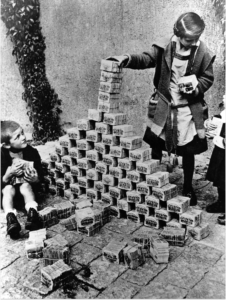
In 1923, banknotes became so worthless that children used to play with them.
Thanks to the constant shift in the value of the German mark, people on fixed incomes, such as students, pensioners and the sick, were among the biggest losers because their incomes failed to keep pace with rising prices.
People with life savings also suffered. Money that had taken years to save could suddenly buy almost nothing.
The winners were business owners, landowners, and people with mortgages.
People who owed money could benefit because their debts remained fixed in marks while the mark itself became almost worthless. A large mortgage or business loan could therefore become much easier to repay.
How did the cycle stop?
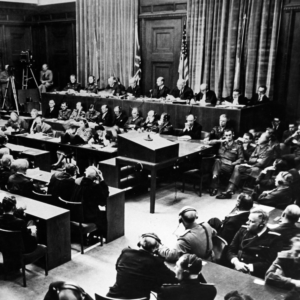
Hyperinflation began to end in late 1923, when the German government ended “passive resistance” in the Ruhr, reduced public spending and introduced a new currency called the Rentenmark.
The amount of new money was tightly limited, helping to restore public confidence. The old paper mark was later replaced by the Reichsmark.
The government also introduced tax and spending reforms. Together, these measures stopped the rapid creation of money and brought prices under control.
The US-backed Dawes Planfollowed in 1924. Led by an international committee and supported by American loans, it reorganised Germany’s reparations payments and helped the economy recover. However, it did not directly stop hyperinflation, which had already ended before the plan came into force.

© 2026 The Oxford School for the Future