


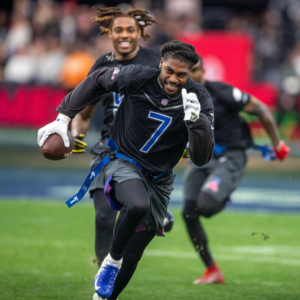
16-year-old Sofia Vorobei examines the reasons behind the viewership drop in this year’s NFL showcase
The Pro Bowl Games – the NFL’s annual all-star game – takes place each year the week before the Super Bowl. At this year’s event, on 3 February in San Francisco, something ugly happened: the Games drew roughly two million viewers on ESPN. That’s one of the lowest totals in the event’s history and a drop of 60% from 2025’s already modest audience of 4.7 million.
For context, we’re talking about a game that used to pull more than six million viewers just a couple of years ago, even after format and location changes. This year’s tiny audience is a huge indicator that fans – especially younger ones – simply aren’t tuning in anymore.
Harbingers’ Weekly Brief
Subscribe to the Harbingers’ Weekly Brief, a newsletter written by the editorial board of Harbingers’ Magazine, the world’s youngest newsroom, delivered to your inbox every Monday morning.
![author_bio]()
![author_bio]()


The Pro Bowl was once one of the NFL’s most anticipated showcases – a chance to see the American football league’s most talented players compete. Pro Bowl players are selected through a combined voting process, with fans, players and coaches each accounting for one-third of the vote to determine rosters – setting the event apart from traditional NFL competition.
So what changed in 2026 that caused interest to drop so noticeably? Well, here are some reasons.
View this post on Instagram
From tackle football to flag football
The Pro Bowl was always an actual 11-on-11 tackle game. This year, however, it became a 7-on-7 flag football competition. This is one of the main reasons for the viewership drop, since many are drawn to American football for its brutality.
The main difference is that flag football removes heavy contact – instead of bringing a player to the ground, defenders pull a flag from the ball carrier’s belt to end the play. Also, the fact that it’s played with fewer players, no pads and no helmets makes the game faster and less physical than traditional tackle football.
However, this shift was made with good intentions.
The NFL is trying to reduce injury risk and position flag football as a global growth sport – especially with the Olympics introducingit in 2028.
But what’s good for global development hasn’t translated into must-see television. Many fans think that flag football simply doesn’t feel like football, with less physicality, fewer big hits and a more relaxed pace overall.
Different scheduling
NFL primetime has become a ritual for many fans. And yet, this year’s Pro Bowl appeared on TV on a Tuesday evening in the middle of Super Bowl week – far from the traditional Sunday afternoon that so many viewers are used to. That timing seems to have made the potential viewership plummet.
Many stars opted out

The whole point of the Pro Bowl is to see the best of the best competing on the same field. This year, however, many stars either didn’t play or never fully bought into the event.
For instance, Chris Jones,defensive tackle for the Kansas City Chiefs, opted not to participate in the event despite being selected. The same goes for his teammate Travis Kelce,who also skipped the Pro Bowl entirely.
Instead, replacements such as Shedeur Sanders,quarterback for the Cleveland Brown – who wasn’t originally selected – ended up playing.
When some of the sport’s most recognisable players treat the Pro Bowl as something optional or unimportant, it’s no surprise that viewership decreased.
Youth’s short attention span
Another factor driving the decline is how younger audiences consume sports today.
Youth’s attention span is shrinking and, in 2026, plenty of younger NFL fans aren’t watching traditional TV broadcasts like older viewers. They’re on TikTok, Instagram, YouTube and social feeds – watching highlight reels, short clips and viral moments. Sitting through an entire flag football game doesn’t compete with 30- to 60-second highlight edits circulating out there on social media.
Taken together, all these factors make the event “not worth it” and some fans are even questioning whether it’s a good idea to hold it in 2027.
The NFL clearly wants to make Pro Bowl safer and more modern, but in doing so it may have stripped away what once made it popular. So either next year it finds a format that actually excites viewers again, or it risks completely losing relevance.

Edited by:

© 2026 The Oxford School for the Future