



16-year-old Irma explains the basics of colonialism
Colonialism is the process by which one state or group takes control of another territory and exerts power over aspects of society, such as the economy, politics and culture. It has shaped, and continues to shape, both domestic and international politics. It has been the bedrock of some of history’s most devastating conflicts.
Colonialism is responsible for millions of deaths across several continents over many centuries. The origins of what we think of as modern colonialism can be traced back to the fifteenth century. In 1415, Portugal captured Ceuta in North Africa, marking the beginning of European overseas expansion.
Portugal, and later Spain, established trading posts and military bases along the African coast. As their economies grew, other European powers began to recognise the economic and political benefits that colonialism brought in terms of resources, wealth and influence.
Harbingers’ Weekly Brief
Subscribe to the Harbingers’ Weekly Brief, a newsletter written by the editorial board of Harbingers’ Magazine, the world’s youngest newsroom, delivered to your inbox every Monday morning.
![author_bio]()


In 1492, Christopher Columbus arrived in the Caribbean, accelerating the first major wave of European colonisation, often referred to as the “Age of Discovery”.
Colonisers attempted to justify their actions through religion and the idea of a “civilising mission”. Missionaries believed it was their Christian duty to spread their faith, claiming they were bringing civilisation and salvation to Indigenous peoples.
In addition, many Europeans believed that, because of their race, they were naturally superior to others and therefore had the right to rule over and exploit them.
However, the deeper ideology behind colonialism was far more self-interested than these justifications suggested. Colonisers sought access to valuable raw materials such as gold, rubber, cotton and minerals, which fuelled growing industries and created new economic markets.
They also benefited from the people they colonised, who were often used as forced labour to build infrastructure, work on plantations and extract resources. Many colonial governments also taxed Indigenous populations to generate further revenue.
Colonies also provided important strategic advantages, enabling European powers to control key trade routes. For example, Britain gained control of the Suez Canal, giving it a vital route to India and the rest of its empire.
View this post on Instagram
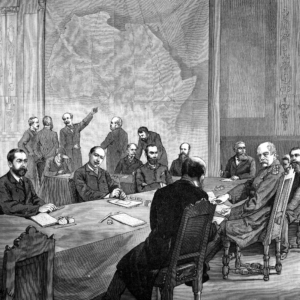
A second wave of colonialism was largely formalised by the Berlin Conference of 1884–85, which was attended by representatives from 14 countries, including Belgium, Britain, France, Germany, Portugal, Russia, Spain, the United States and the Ottoman Empire.
The meeting focused on regulating the colonisation and trade of Africa. Its aim was to reduce conflict between the European powers as competition for African territory intensified during what became known as the “Scramble for Africa”.
The conference introduced the principle of effective occupation, meaning that a country could only claim territory if it had physically established authority there, for example by setting up an administration, maintaining troops or signing treaties with local rulers.
Another important outcome was the signing of the General Act of the Berlin Conference, which committed the powers to suppress the slave trade and guaranteed freedom of trade and navigation along the Congo and Niger rivers.

The conference also recognised King Leopold II of Belgium’s personal control over the Congo Free State (now the Democratic Republic of Congo). Leopold went on to brutally exploit the region for rubber production through forced labour, violence and starvation, leading to an estimated ten million deaths.
This second wave of colonialism transformed Africa politically, economically and socially. By 1914, almost the entire continent had been divided between European powers, with little regard for existing ethnic groups, cultures or political boundaries. These artificial borders later contributed to civil wars, ethnic conflict and political instability, which continue to affect many African states today.
Today, colonialism continues in different forms. While most former colonies have gained political independence, many remain economically dependent on wealthier countries through trade, debt and foreign investment.
Large multinational corporations continue to extract natural resources from developing countries, often with limited benefits for local populations. Former colonial powers also continue to exert influence through international institutions, military alliances and cultural dominance.
As a result, many scholars argue that neo-colonialism has replaced direct colonial rule, meaning that although colonialism no longer exists in its traditional form, many of its structures and inequalities continue to shape global politics today.

© 2026 The Oxford School for the Future