



Klara and Mikołaj, both 17, and Kaja, 16, interview a three-time Oscar-nominated filmmaker

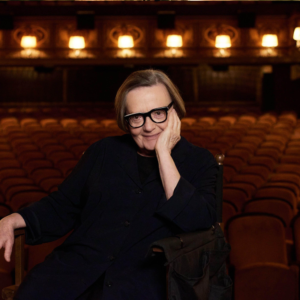
Director Agnieszka Holland during the promotion of Franz.
9 February 2026
‘When people lose the right to security, you open the way to fascism,’ says Agnieszka Holland
Agnieszka Holland is a globally acclaimed film director known mainly for historical and politically charged pictures.
Her Green Border (2023) was about the refugee crisis on the Polish-Belarusian border and received the Special Jury Prize at the Venice Film Festival. Mr Jones (2019) tells the story of the Holodomor, the starvation of Ukraine by the Soviet dictatorship in the 1930s.
For Europa Europa (1990), she received a Golden Globe Award and was nominated for an Academy Award – it was one of her three pictures that was nominated for an Oscar, alongside Angry Harvest (1985) and In Darkness (2011).
Last year, Holland released Franz, a film about the life of the Czech-Jewish writer Franz Kafka (1883–1924), the author of classics such as The Trial (1925) and The Castle (1926) – works that survived only because the writer’s friend refused to carry out Kafka’s final request to destroy all his writings.
Harbingers’ Magazine spoke to Holland about her new work as well as the political and social motives in her movies.
The following excerpt from the recorded interview was edited for clarity and consistency.
Mikołaj Tran (MT): What drew you to Franz Kafka as a subject of a film?
Agnieszka Holland: Not only as a subject of the film, but as a human being and an artist, Franz Kafka is very important to me.
The first novel I read was The Trial, and that was something completely different from what I knew. It showed the world a new way to see reality and opening new perspectives is very relevant to me, maybe because I was living under the communist bureaucracy.
Then I started to read his letters and diaries. I felt like he’s somebody close to me, that I understand him somehow, or at least that I know him better. I thought that maybe I could protect him, his very blurry identity, and the fact that he was different.
That made him somebody who was personally very interesting and touching. He was one of the reasons why I went to Prague, the city of Franz Kafka, to study cinema. Then in the 1980s I adapted The Trial and started to think about a possible biography.
When I was shooting movies there, I noticed this ironic situation that Franz Kafka was practically unknown to the Czechs before the Velvet Revolution of 1989. That’s because he was not interesting to the Czech general audience before War World II, and after the war, when Czechoslovakia became one of the most ‘Iranian’ countries, he was practically forbidden [by the Soviet authorities], as he was considered a bourgeois degenerate writer.
With political freedom and economic freedom came also the realisation that Kafka is important – quite quickly he became a part of the tourist industry, someone who deserves monuments and museums.
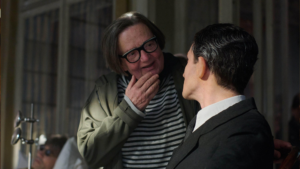
Kaja Majewska (KM): In the film, Franz admitted himself into a care home. We were wondering if this actually happened or was this just a metaphor you used to portray his thinking processes?
This actually happened. The doctor who was the head of that institution had an idea of curing people via nudity; the point was to get reborn. We found several photographs from there and it is so absurd, the fact that Kafka was there. But it was probably his father who advised him to do it.
KM: What about the final scenes, where most of the men are wearing fake animal heads? What did you mean by that?
That is after death. Because the scene before is when he’s in the care home, when it’s clear that he came there to die. It means you are free, naked, that the men and animals are the same. That is the vision of paradise – I thought that for Franz, paradise was to feel well in his body, and among others.
What’s interesting is when we were shooting the film, I asked Idan Weiss, the actor who plays Franz, to take his clothes off. He told me that he doesn’t want to do it, that he doesn’t feel comfortable with it.
He explained that as a teenager he was bullied by other teenagers because of his body. So I told him: “OK, you will have some kind of suspender, we will hide it with the high grass.” It had to look like he was naked, that was the point of the scene.
Therefore, we started to prepare it in that way, and just before the first rehearsal, he came to me and he said: “Yeah, I can do it, I can get naked.” It was a kind of liberation for him, somehow.
Harbingers’ Weekly Brief
Subscribe to the Harbingers’ Weekly Brief, a newsletter written by the editorial board of Harbingers’ Magazine, the world’s youngest newsroom, delivered to your inbox every Monday morning.
![author_bio]()
![author_bio]()
![author_bio]()


KM: In many of your films the characters you focus on are not the decision makers nor important historical figures, yet they are crucially important in the social and political course of the world. Where did that approach come from?
The characters and subjects I portray come to me from my thoughts, from my sensibility. I’m not analysing myself so deeply because I think that if I start to analyse how I do things, I would lose the desire to express it. In reality, it just reflects my character. I think to myself: “Why are characters like that so important to me?” And then I explore.
All of my films are coming from my desire to know more, to understand better, to approach or to look at people or mechanisms which somehow are mysterious to me.
Moreover, most of the things in the world are mysterious to me.
Klara Hammudeh (KH): I was reading reviews of your Green Border. A lot of people did not agree with the ideas that you presented there. How do you feel about the public reaction to this? Does it affect you?
The reaction was mixed because we are living in a deadly polarised society and we don’t have common values. It’s very difficult to find common ground, to find the authority, to be compatible.
I don’t believe that when I touch a subject that is difficult politically and controversial socially I will find everybody agreeing with me. My goal with a film like that is to express the reality as objectively as I am able to and, in a way, that is as human as possible. Also to awaken some kind of sensibility, when regarding other destinies and other choices of people who are not from our zone, from our zone of comfort.
I think personally it’s not controversial. The situation of mass migration channels, which is manipulated by politicians from hostile countries.
My goal wasn’t to deal with that politically and practically, it was to show that in the moment when you legalise the fact that some human beings don’t have the rights to security and life, you open the way to real fascism. It also means that the values we built our lives on after WW2 are not viable anymore.
KH: You want to build up a sense of responsibility?
Well, we are responsible for other people, aren’t we? In Green Border I’m showing a very precise situation when in my forest, in my country, people are dying just because we are cruel to one another.
What is our part of the responsibility in their death and life? Some people say: “OK, their choice was their choice, they crossed the border in an illegal way, They are responsible for their destiny.”
However, thinking that way we can easily justify all wars and all the cruelty happening. We are opening Pandora’s box.


© 2026 The Oxford School for the Future