


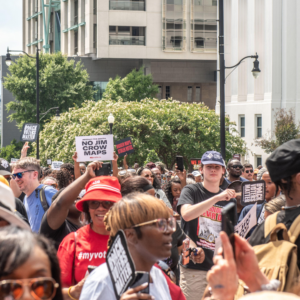
17-year-old Ava explains the implications of recent changes to the Voting Rights Act
With November’s US midterm elections fast approaching, voting rights have once again become one of the most contested issues in American politics.
Lawmakers, judges and election officials are debating voter ID requirements, mail-in voting rules, congressional district maps and the role of state governments in overseeing elections.
At the centre of these debates is the Voting Rights Act of 1965, one of the most significant pieces of civil rights legislation in American history. The Act aimed to enforce the Fifteenth Amendment’s promise that Americans could not be denied the right to vote because of their race.
Harbingers’ Weekly Brief
Subscribe to the Harbingers’ Weekly Brief, a newsletter written by the editorial board of Harbingers’ Magazine, the world’s youngest newsroom, delivered to your inbox every Monday morning.
![slide image]()
![author_bio]()
![author_bio]()


It outlawed discriminatory practices used against Black Americans in the South, such as literacy tests, and also gave the federal government greater authority to oversee elections in states with histories of voter suppression.
The Act was passed with broad bipartisan support, reflecting a rare moment when both Republicans and Democrats agreed on the need to protect voting rights and strengthen American democracy. For decades, historians credited the Act with dramatically increasing voter participation and political representation among Black Americans and other minority communities.
Yet many of the protections that made the Voting Rights Act so powerful have faced growing challenges in recent years. Court decisions have weakened portions of the law, and on 29 April the Supreme Court issued a 6–3 ruling that critics argue further limited protections against racial discrimination in congressional redistricting.
Supporters argue that these changes strengthen election security and public trust, while critics contend that they make voting more difficult for certain groups of Americans.
View this post on Instagram
Redistricting
One of the most important ways the Voting Rights Act protected minority voters was through redistricting. This is the process of redrawing the geographic boundaries that determine which voters belong to which electoral districts. It usually occurs once every ten years, after the US census, so that districts reflect population changes and contain roughly equal numbers of people.
Most maps are drawn by state legislatures, although some states use independent or bipartisan commissions. Rules for public involvement vary: residents may be able to submit proposed maps or speak at public hearings, but they do not vote directly on most final plans. States may also redraw maps between censuses, depending on state law or a court order.
District lines determine which voters elect each representative, so map-makers are supposed to create lawful districts that fairly represent population shifts. However, the party controlling the process may also draw boundaries to improve its electoral prospects, a practice known as partisan gerrymandering.
For decades, Section 2 of the Act allowed courts to challenge district maps that diluted the voting strength of racial minorities. The Act sought to prevent practices such as “packing”, where minority voters are concentrated into a small number of districts, and “cracking”, where they are split across many districts to weaken their collective influence.
In some cases, courts required the creation of “majority-minority” districts, in which a racial or language minority makes up more than half of the voting population. These districts can prevent minority voters from being dispersed among several districts and give them a realistic opportunity to elect candidates of their choice.
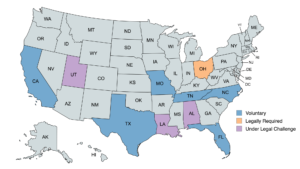
However, in April, the Supreme Court ruled that challenges under Section 2 should focus primarily on proving “intentional racial discrimination”. Before, plaintiffs had to prove only discriminatory effect rather than intent.
Thus this new ruling makes it more difficult to challenge district maps that weaken the power of minority voters. Proponents, however, argue that it limits the use of race in the redistricting process.
Redrawing district maps
Following the Supreme Court’s decision, several states are redrawing (or considering redrawing) their congressional maps ahead of the midterm elections.
The movement began when Texas lawmakers pursued new district boundaries that are likely to increase Republican representation in the House of Representatives.
In response, other states including California considered their own redistricting efforts. Additional map disputes have emerged in states such as Alabama, Indiana, Louisiana, Maryland, New York, South Carolina and Washington, reflecting how battles over district lines have become intertwined with broader partisan competition.
As both Democrats and Republicans seek advantages in closely contested elections, redistricting has become one of the most consequential – and controversial – tools for shaping political representation before voters have even cast a single ballot.
Criticism of the Supreme Court
Voting rights advocates have strongly criticised the Supreme Court’s decision, arguing that it weakens protections that minority communities have relied on for decades.
Wilfred Codrington III, a constitutional law professor at Yeshiva University’s Cardozo School of Law in New York, noted that many of the states most affected by the ruling are located in the former Confederacy (the 11 southern states that supported slavery), where battles over voting rights have historically been most intense.
“Today the bulk of Black people live in the states of the old Confederacy. And that is exactly where you’re seeing the worst types of retrenchment,” he said.
Civil rights organisations have expressed similar concerns. Following the ruling, Deuel Ross, director of litigation at the NAACPLegal Defense Fund, argued that the decision would make it easier for states to reduce minority representation without facing legal consequences.
Ross calledthe ruling a setback for voting rights protections and pledged to continue challenging district maps that his organisation believes weaken the political influence of Black voters.
Challenging voter suppression
For voting rights advocates, the question now is not only what was lost, but what can still be done. Many organisations are pushing for new federal legislation to restore and expand the Voting Rights Act, while also challenging voter suppression laws in state and federal courts.
Groups such as the League of Women Voters argue that voter suppression today can include discriminatory voter ID laws, attacks on registration, voter purges, reduced polling locations, and limits on early or mail-in voting.
In other words, the fight is no longer only about whether someone can vote, but whether election systems give all communities a fair and equal chance to participate.
Additionally, some advocates are encouraging voters to pay attention not only to presidential or congressional elections, but also to school boards, county commissions and state legislatures, where redistricting decisions can shape representation for years.
The Supreme Court’s ruling is difficult to reverse through the courts because it came from the nation’s highest court, but it is not necessarily permanent. Congress could pass new voting rights legislation, states could adopt stronger voting protections of their own, and communities can continue disputing specific maps through legal challenges and public protest.

Edited by:

© 2026 The Oxford School for the Future