




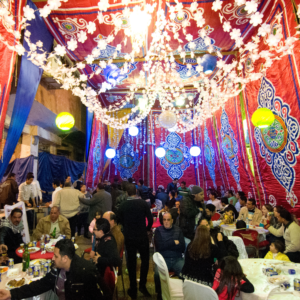
17-year-old Mutaz explains how Egyptians celebrate the birth of a child
Mutaz Sameh is the one of the winners of the Harbinger Prize 2025. This is his winning entry.
In every Egyptian household, the result of a successful pregnancy brings more than just a child; it brings company. Since the days of the pharaohs, Egyptians have celebrated the birth of their children with great pride, holding a large festival on the seventh day after the child’s birth, sometimes attended by the whole neighbourhood.
This one-day festival is called Suboo, which means seventh day in Arabic. The ancient Egyptians regarded the number seven as a symbol of completeness, as it was associated with the Egyptian deities, the afterlife and, above all, the River Nile.
The ‘bread basket’ of the Mediterranean had a standard measure, the cubit, which was divided into seven palms. The cubit was developed for a number of reasons, many of which were crucial to Egyptian agriculture, including calculating the size of farmland, planning irrigation canals and measuring the level of the Nile.
As the number seven had significance in Egyptian society, it was only logical that it would eventually be associated with health – children who lived until the seventh day were considered healthy.
Before the celebration starts, there are a few things that need to be done. Such as the decorations. For example, if the child is female, the family decorates the house with numerous jars, which were used to symbolise childbirth and motherhood in ancient Egypt. For males, the parents decorate the house with jugs, which symbolise fertility.
Then comes the baby’s clothes. Surprisingly, unlike how children are clothed in most countries, the child, whether male or female, wears the same long dress.
Harbingers’ Weekly Brief
Subscribe to the Harbingers’ Weekly Brief, a newsletter written by the editorial board of Harbingers’ Magazine, the world’s youngest newsroom, delivered to your inbox every Monday morning.
![author_bio]()


Lucky seven
As I learned more about a part of my own heritage, I became fascinated with Suboo, so I decided to call an expert.
“Everything begins on the ground, where life began,” says Mrs Umm Mazen from Alexandria, who recently conducted a Suboo for her own child. I interviewed her to find out more about this fascinating national tradition.
“The mother places the baby in a basket and then lowers the basket to the floor. Then the mother hops over the basket seven times in different directions,” she explains – reminding me once again of the significance of the number seven in ancient Egypt.
According to Mrs Mazen, the baby recognises the mother’s scent when she jumps over her child and begins to bond with her more closely.
She continues: “After this intimate moment, the mother gives many sweets to her relatives, who distribute them to all the children in the neighbourhood they can find, to invite them into their home to participate in the next step of the ceremony.”
After the children have gathered in the house, seven lighted candles are distributed to them, in reference to the seven cows of Hathor, the sun goddess. The children form a circle around the child and turn around him seven times, explains Mrs Mazen.
Now comes the noisy part of the celebration. The mother bangs a mortar and pestle together, making a loud noise that alarms the baby, while giving commands like “Don’t listen to your father, listen to your mother instead.”
At first, I didn’t understand why the mother would do something like that. However, after doing some research, I came to two conclusions.
First, in ancient Egypt, and even today, mothers occupy an almost sacred place in the family. Although societies in this part of the world were, and still are, strictly patriarchal, the mother is the one who runs the household. Many children show more emotion towards their mother, as a sign of respect for her role in their upbringing.
However, there is another reason for pounding the mortar and pestle. The ancient Egyptians believed that a child’s hearing begins to develop on the seventh day after birth – so they are trying to help that process.
Merging traditions
With the arrival of Islam in Egypt in the seventh century, other customs merged with those of Suboo, creating a unique blend of traditions. For example, the Islamic tradition of Aqeeqah is also celebrated on Suboo: a butcher arrives to sacrifice an animal, usually a sheep or a goat. This sacrifice is intended to thank Allah for the child’s health.
Another interesting non-Egyptian invention in Suboo is that the parents prepare cups of mughat, a hot drink consisting of butter, sugar, nuts and, most importantly, roots from the plant Glossostemon, which gives the drink its unique and sweet taste. It is also supposed to help the mother’s lactation.

Unrelated to religion, Arabs introduced incense to Egypt. Since then, Egyptians have used incense at all major festivals and also in everyday life, as it produces a very pleasing smell that diffuses across the house.
Mrs Mazen tells me that the parents’ relatives sprinkle salt on the ground, another common precaution to keep the evil eye away. They also say prayers for the baby and wish him a long and happy life.
Seven grains are also part of the celebration. However, instead of scattering them on the ground, they are all put in a pot and placed next to the child, to bring good luck.
The seven grains are usually wheat, beans, chickpeas, lentils, barley, rice and fenugreek. Even the process of adding the grains has a purpose. For example, when sieving the grains to separate out impurities, it is believed that unhappiness is also filtered out, leaving the grains with all the happiness and good luck that is necessary for the child.
In more rural areas of Egypt, parents finish the celebrations by staying in a picturesque place in the belief that by visiting beautiful areas, the child will grow up to be beautiful too.
A lesson in culture
As an Egyptian, it was surprising for me to learn that an event as important as Suboo is not only connected to ancient Egypt, but also to the greater Middle East.
I like the fact that we Egyptians love to introduce foreign culture and traditions to our own, as long as it’s about having a good time! In all seriousness, though, I love all the diversity that comes with it.
I loved learning more about both my culture and religion, an opportunity that Suboo gave to me as it’s related to both. I also really enjoyed learning more about the strange but interesting traditions that we maintain, even though we knew nothing about their origins until relatively recently (Egyptology is little more than 200 years old).
And I’m very much looking forward to taking part in a Suboo myself one day – although I hope it isn’t as loud as it’s made out to be!

© 2026 The Oxford School for the Future