


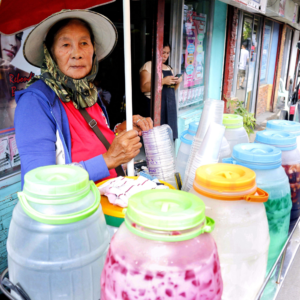
18-year-old Ryleigh explains how to combat the spread of treatment-resistant pathogens in the Philippines
Whether it be the dry or wet season, palamig or cold beverages sold by street vendors are always a staple in the streets of Manila, the capital of the Philippines. Despite being a popular way to combat the heat and humidity year-round, these drinks aren’t always compliant with food safety standards.
Now, researchers from the University of the Philippines Manila College of Public Health are sounding the alarm after antimicrobial-resistant bacteria were found in drink samples in Tondo, the largest and most densely populated district in Manila.
Antimicrobial-resistance (AMR) occurs when bacteria, fungi, viruses and parasites adapt and stop responding to antimicrobial medicines, making diseases and infections almost impossible to treat. This can be caused by the overuse or misuse of antibiotics, as studies have found they can become resistant to antibiotics in just 11 days. This means that diseases that are caused by AMR bacteria are often incurable.
In 2021, bacterial AMR led to 4.7 million deaths worldwide and was the fifth most common cause of death in the Philippines.
View this post on Instagram
AMR transmission in local communities
Although palamig have been found to carry such bacteria, street food stalls aren’t the only places these strains of bacteria could be spreading through communities in the Philippines.
A UP Manila study published in June discovered that hospital wastewater was found to carry E. coli bacteria with antibiotic-resistant genes. This means it has the potential to contaminate the environment even after treatment.
Each hospital is required to treat their sewage, which removes 95% of bacteria. But using recycled water for toilet flushing and watering plants means that transmission to humans and animals is still possible.
Harbingers’ Weekly Brief
Subscribe to the Harbingers’ Weekly Brief, a newsletter written by the editorial board of Harbingers’ Magazine, the world’s youngest newsroom, delivered to your inbox every Monday morning.
![slide image]()
![author_bio]()
![author_bio]()


Not all water sources in urban areas can be regulated, monitored and managed. For example, estuaries and rivers in the Manila area contain antimicrobial-resistant E. coli bacteria. These bodies of water are likely to spread AMR pathogens to people, but this does not stop locals from swimming in them, particularly in summer.
Agriculture is also a potential source. Highly polluted surface water used to irrigate some farms in Metro Manila has been found to carry E. coli strains with 67.3% resistance to antibiotics. They have also produced vegetables carrying bacteria with 61.5% resistance to antibiotics.
Such occurrences aren’t isolated to urban settings. Bacterial groups abundant with numerous AMR genes were also found in Laguna Lake, the country’s largest lake, located southeast of Metro Manila, where fishing is common.
Kenneth, an 18-year-old college student who frequently drinks street-stall beverages, told Harbingers’ he knew there were risks to drinking them such as catching sicknesses from germs and bacteria, but was unaware of their possible antimicrobial resistance.
“Surely, I’ll be buying less from these street stalls from now on. It would be better to buy from places I trust… their spots are cleaner and are documented,” he said, referring to stalls with proper health safety certification.
This caution is not without reason, as the same UP Manila study which discovered the presence of AMR bacteria in street beverages found that vendors had little to no knowledge on how to maintain food safety and reduce AMR risks.
Ways to avoid contamination
The public health issue of AMR cannot be solved through merely avoiding street food and rivers in urban areas, or pushing vendors to be more hygienic. Action from the government is key too.
UP Manila’s Social Transformation Advocacy towards Public Health (STAPH) emphasised in a public awareness campaign that a stronger system for health, food and environmental safety must be implemented to stop the spread of resistant bacteria.
STAPH urged the government to strengthen food safety regulations through regular inspections, mandatory vendor support programmes, more access to cleaner water and better infrastructure for sanitation and waste management.

It also highlighted the need for wider AMR awareness campaigns to teach the dangers of antibiotic abuse and prevent the further development of AMR bacteria.
“This isn’t simply an issue of contamination. This is a systematic public health concern connected with water, cleanliness, urban inequality and quality of food systems,” the organisation said.
The Filipino government is currently implementing a multi-departmental plan to combat AMR in the country, called The Philippine National Action Plan on Antimicrobial Resistance 2024–2028: A One Health Approach (PNAP). The goal is to cut high-risk drug-resistant infections by 10% by 2028.
Although holistic action from all sectors is needed, citizens need to mindful of potential sources of AMR pathogens (such as urban estuaries, unsanitary food stalls, bodies of water near wastewater treatment plants) and avoid them, if possible.
Moreover, antibiotics should only be taken for the recommended duration, as prescribed by a medical professional, in order to prevent bacteria from developing resistance to it.

Edited by:

© 2026 The Oxford School for the Future