


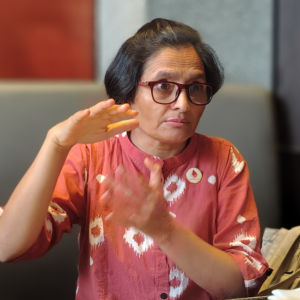
16-year-old Irma interviews Nepalese activist Dr Radha Paudel on the importance of menstrual rights
Inequality between women and men is written into the very bedrock of modern civilisation. Pioneers such as Dr Radha Paudel devote their lives to digging down and laying this bedrock bare, which is covered by layers of concrete and clay. Paudel argues that it is menstrual discrimination – an issue that is rarely mentioned – that is found at these depths.
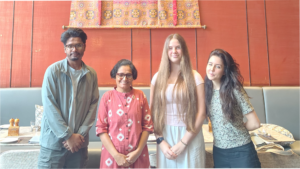
An award-winning Nepalese writer and activist, 52-year-old Paudel started a foundation in 2016 to achieve full and genuine equality for people who menstruate. I sat down with the spirited activist to discuss her work, in a room that shielded us from the monsoon heat of Kathmandu, Nepal.
Paudel’s lifelong passion was shaped by her personal experience. At the age of only six, she found herself at the mercy of a cruel and oppressive narrative about her basic human functions. The story she was told was that one day she would bleed and become impure; forbidden to touch household objects, men or enter the kitchen.
This shame was soon buried in silence, and began to govern her life. The power of the fiction became so overwhelming that she pleaded with the gods to make her a man, to end her menstruation, and even to take her life. “It was not happening,” she said. At the age of nine, she fled home and attempted suicide.
Paudel’s experience is not an isolated one. In one way or another, women across the world experience menstrual discrimination. This issue is harder to detect – and more difficult to defeat – than any national government admits.

If developed countries believe that they have risen above such attitudes, Paudel is determined to prove them wrong. “Menstrual discrimination is everywhere,” she says.
For Paudel, the definition of menstrual discrimination is clear: “Silence, taboo, restrictions, stigma, abuse, violence, [and the] denial of resources and services that are needed throughout life for people who menstruate.”
Although developed societies have eliminated certain discriminatory practices, the stigma associated with menstrual blood persists in nearly all areas of life. It is common for girls to consider their cycles embarrassing, conceal menstrual products and change their daily habits when they are on their period.
It is common for people who menstruate to take popular narratives about menstruation at face value. Women readily adopt the message that periods are painful, weakening and mood-altering, despite the fact that such symptoms are not remotely universal.
Paudel argues that the stereotyped image of a person menstruating – snuggled under a blanket, crying, eating chocolate – can even increase pain psychologically and hide what a person is really feeling. Such forms of discrimination are often extremely subtle, and for this reason more sinister and pervasive.
“It’s not about poverty. It’s not about religion. It’s not about region. It’s not about education. It’s about the silence,” she says.
Emphasis on menstrual products
As a result of this silence, the efforts of Western aid in other countries is built on broken assumptions. It focuses primarily on the distribution of menstrual products, such as pads, tampons and cups.
In doing so, it overlooks the most fundamental element of menstrual discrimination: the belief that the menstrual cycle is shameful, impure and disqualifies a woman from full social participation. The mere availability of modern products, Paudel claims, “does not guarantee the dignity for the person menstruating”.
The problem is yet more troubling. By focusing on the distribution of products, the West reinforces the narrative that they have solved the problem of menstrual discrimination merely by having abundant resources. The distribution of such products gives policy-makers licence to close the discussion, so that international action continues to fall short of global need.
View this post on Instagram
Moreover, the product-centred approach comes bearing the baggage of capitalism. Companies relish the opportunity to distribute free sanitary products, but primarily as a means of entering markets early and establishing brand recognition in emerging economies. Such companies, Paudel observes, “are not looking to empower the people who menstruate”.
Rather, their profit-driven outlook compounds the failure to address menstrual discrimination at its social and psychological roots. As companies seek to lower costs or to stand out among competitors, they may even pursue undermining strategies, such as the use of harmful fragrances and toxic chemicals. “It’s all about the money,” says Paudel.
Harbingers’ Weekly Brief
Subscribe to the Harbingers’ Weekly Brief, a newsletter written by the editorial board of Harbingers’ Magazine, the world’s youngest newsroom, delivered to your inbox every Monday morning.
![author_bio]()
![author_bio]()


A positive future?
Women such as Paudel, who advocate for menstruation rights, are frequently looked down upon in political spaces. “They don’t count us. They don’t see us as creators of life; as important entities of this universe,” she says. As a result, attitudes towards this issue among policy-makers are often dismissive and condescending. Paudel favours an open, nuanced and relentless approach, which places dignified menstruation at the centre of women’s rights discourse.
Despite immense challenges, Paudel adopts a positive outlook on the future, and says that many societies are slowly but surely changing tune. For example, German-based charity WASH United set up the Menstrual Hygiene Day campaign, celebrated annually on 28 May. In 2024, Menstrual Hygiene Day saw more than 1,500 organisations collaborating globally to promote awareness.
Closer to home, in Nepal, there have also been improvements. On 21 March 2025, Nepal’s National Assembly unanimously endorsed dignified menstruation. Paudel describes the occasion as an historic milestone for both human rights and the global menstrual movement – even as the road ahead remains long.

Edited by:

© 2026 The Oxford School for the Future