

17 -year-old Lisindi from the Sri Lankan Newsroom explores how the Middle East conflict is affecting international students
On 2 April, UK exam board Pearson Edexcel announced that in-person exams for the International GCSE, the International A Level and iPLS qualifications have been cancelled in the Middle East for the May/June 2026 series. The countries affected so far are Bahrain, Kuwait, Qatar and the United Arab Emirates.
Ever since the announcement, there has been much argument and speculation among international students about whether exams should be postponed in other places too.
Many worry that with fewer students sitting May/June A-level exams, grade thresholds could rise beyond what they prepared for, decreasing the number of students who pass exams.
As an A-level student preparing for these exams, I firmly believe that postponing these exams worldwide until October is the most reasonable course of action. Below I explain why.
Harbingers’ Weekly Brief
Subscribe to the Harbingers’ Weekly Brief, a newsletter written by the editorial board of Harbingers’ Magazine, the world’s youngest newsroom, delivered to your inbox every Monday morning.
![slide image]()
![author_bio]()
![author_bio]()


Health and safety concerns
In June 2019, thousands of students in northwest Syria were forced to sit their primary and secondary school exams amid a bombing campaign. The Syrian Interim Government had postponed the original exams and relocated testing centres after intensified airstrikes.
An Arabic language teacher Bara Idlibi said at the time: “The biggest challenge that faces the students is the lack of appropriate conditions for studying, especially the continuous bombing in the area, which has lasted for more than a month.”
Beyond the immediate danger, students also carried the emotional burden of worrying about friends and family in conflict zones, further distracting them from their education.
This is why it makes sense for Pearson to postpone exams in countries directly impacted by the current war in the Middle East. But it also affects other countries in the region.
Having large enclosed places for students sitting for exams can risk students, invigilators and families’ health and safety significantly. Even in areas where there is no direct violence, living or travelling near a conflict zone can be extremely stressful for students and their families.
Disruption to education
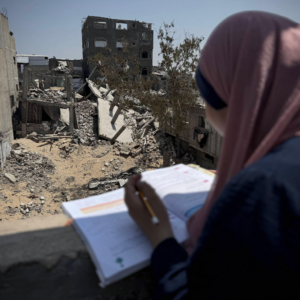
According to Save the Children, at least 52 million school-age children have been forced to stop school, moved to online learning or had their education disrupted by the current violence in the Middle East.
That figure is from mid-March, so the total is likely to be even higher now, as the conflict moves into its third month, with no sign of a final end to the fighting and disruption.
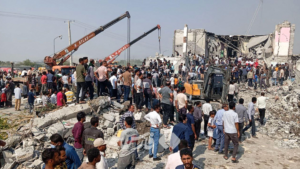
Save the Children’s Ahmad Alhendawi said: “In every conflict, classrooms are usually the first to close and some of the last places to reopen. Every missed lesson deepens the scars of war. Not every child can escape the violence or afford to move their learning online – we know that for the most vulnerable children, once they leave school, many will never return.”
Although online learning is safer, it can never replace in‑person teaching, especially for subjects requiring practical work or laboratory experience. Students who lose access to labs, face‑to‑face tuition or school counselling are at a disadvantage compared with peers who continued normal schooling.
View this post on Instagram
A 16-year-old A-level student from Iran, Amir Ahmadi, told Harbinger’s Magazine: “We feel disadvantaged compared to students in other countries where schooling continues normally.” He said that internet restrictions and limited resources make online learning difficult. Travelling to exam centres is also a problem, because “families constantly worry about safety when travelling – this stress alone affects exam performance.”
Amir concluded: “If exams were postponed globally, all students would have a fair chance of passing exams and getting a better life for ourselves.”
Protecting students’ mental health
Sitting high‑stakes exams while worrying about family, friends and personal safety is an unreasonable burden for students living in war zones. It also robs them from achieving their maximum potential during exams.
Israel has not cancelled exams like other countries in the region. This means that Israeli students face the same issues of travel restrictions, security alerts and the constant stress of living near conflict.

A 17-year-old A-level student from Israel (who asked to remain anonymous) described the situation as incredibly “unfair”, explaining that students are expected to sit exams under normal conditions despite ongoing instability. She argued that preparing for major exams requires a stable environment where you can focus properly.
“I worry constantly if my family and I will survive the night,” she said. I know that many of my classmates had to move to the countryside or switch to studying online because their families didn’t feel safe in the city.”
She added: “Postponing exams worldwide would give students like us a fair chance to prepare properly without the fear that something outside our control will ruin our future.”

Edited by:

© 2026 The Oxford School for the Future