



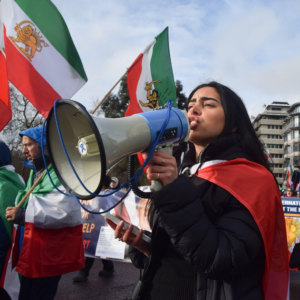
18-year-old Noah analyses what experts are saying about the outcome of the Iranian unrest
The Islamic Regime in Iran is facing immense pressure from anti-government protests that have spread across all 31 of the country’s provinces, starting on 28 December 2025. The catalyst was a collapse in the country’s currency value, though the protesters’ grievances have culminated due to decades of political oppression and human rights violations.
Widespread protest has been met with violence, and it’s not clear, due to widespread internet and electricity blackouts and chaotic conditions, whether the death toll amounts to a couple of thousand or tens of thousands of protestors.
A separate compilation of hospital records provided to Time magazine by Dr. Amir Parasta, a local health official, put the death toll at 30,304 as of 23 January, though it probably misses fatalities recorded at military hospitals or in areas the review did not cover.

That internal figure far exceeds the 3,117 deaths the regime reportedon 21 January and is much higher than activist counts (HRANAhas verified 5,459 deaths and is probing 17,031 additional cases).
The support for regime change has presented itself through protests in cities throughout the world. The Iranian diasporaalso took the streets in support of their people. A protester in London went viral for tearingdown the Iranian flag at the Iranian Embassy (symbol of the establishment of the Islamic revolution), replacing it with the pre-revolution flag, linked to their Persian ancestry.
The royal family of Iran fled in 1979 following the Islamist takeover, meaning that the exiled heir to the throne, Reza Pahlavi,has had to live in the US. The eldest son of the former Shah of Iran has continued to voice his support for the protestors, as well as a secular and democratic Iran.
US politicians, from left-wing Democrat Alexandria Ocasio-Cortez to far-right President Donald Trump, have spoken out in favour of regime change in Iran, and Trump threatenedaction if protesters continued to be killed.
The European Union has added Iran’s Islamic Revolutionary Guard Corps (IRGC) to its terrorist list, placed new sanctions on Iranian companies and politicians, and extended the ban on military drone exports to Iran.
With many thousands of protestors fighting against the oppressive Islamist regime in Iran and with the backing of foreign entities, many are beginning to wonder if the regime will fall. Nevertheless, widespread blackouts and fuzzy death tolls make the situation foggy, as the future remains unclear.
Will international parties intervene in Iran? If the regime falls, will Iran return to a monarchy or adopt democracy? Can the Islamist regime in Iran continue to suppress protestors over a prolonged period of time?
These are all valid questions to be asking at this point in time, in which Iran may be transitioning into a liminal space. This piece analyses some of the possible scenarios.
View this post on Instagram
Slow transition due to the fragmentation of elites
For Amanda Paul, deputy head of Europe in the World Programme and senior policy analyst of the European Policy Center, “Iran’s crisis is no longer episodic; it is structural.” There are competing and weakened factions within government, security and clerical elites. To secure their place and control civic unrest, the elites could compromise by slowly transitioning to democracy without losing some of the privileges they have amassed.
But, for Joe Varner, deputy director of the Conference of Defence Associations, it is also true that there is no organised internal opposition movement to provide a leader if conditions were favourable; meaning a fragmented political power that is willing to work together for a restoration.
Officials in Iran’s leadership are reportedly seeking safety in Europe, with members of former president Hassan Rouhani’s family and Parliament speaker Mohammad Bagher Ghalibaf said to be applying for French visas, a French‑Iranian journalist told Le Figaro. The report says defections at high levels are increasing.
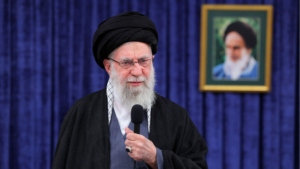
Allegedly, the Iranian leader Ayatollah Ali Khamenei has a contingency ‘plan B’ to flee with close aides if security forces refuse orders – possibly to Moscow – while preparations reportedly include evacuation routes and securing overseas assets. If this was to happen, transition will still need to be with cooperation and uncomfortable conditions.
Harbingers’ Weekly Brief
Subscribe to the Harbingers’ Weekly Brief, a newsletter written by the editorial board of Harbingers’ Magazine, the world’s youngest newsroom, delivered to your inbox every Monday morning.
![slide image]()
![author_bio]()
![author_bio]()

Continued repression until armed groups start civil war
In March 2011, peaceful pro-democracy protests against authoritarian President Bashar al-Assad’s rule filled the streets in Syria. However, after the government brutally cracked down on and killed thousands of protestors, the protests turned into a violent, 13-year Syrian civil war, in which about 580,000 individuals were killed and 13 million Syrians were forcibly displaced.
If the Iranian regime cannot contain protestors, and the protestors arm themselves, the situation will likely change from protests to a violent civil war.
While rival factions in the Islamic Revolutionary Guard Corps and different political groups might compete for control, some do not believe tensions will amount to civil war because Iran’s circumstances are quite different from Syria or Libya.
For instance, Iran has a strong longstanding bureaucracy, a cohesive national identity and seemingly little appetite for civil war. Thus, larger forms of armed conflict would likely be limited to provinces that border Afghanistan, Pakistan or Iraq, where neighbouring states such as Turkey may chip in to act against instability. Nevertheless, even under these conditions a full-scale civil war is unlikely.
US military intervention or more Cold War-like tensions with Iran
Thus far, US policy has focused on applying pressure to Iran’s Islamist regime rather than directly forcing regime change with a military intervention. President Trump, as well as other senior officials on all sides of the political spectrum, has condemned Iran’s violent crackdown on protests.
Trump has saidthat the US is “locked and loaded” in case repression intensifies, but actions have not moved further than redirecting a US Navybattle group towards Iran, and imposing sanctions to weaken the regime’s already deteriorated financial state in the hope that it will deter further repression and regional escalation.
Varner also points out that the Iranian regime could focus on regional escalation to keep protesters and elites at bay. He says “a regime that appears constrained at home may be more volatile abroad.” But, it’s a great risk: “External action can temporarily arrest internal decline, but it raises the risk of miscalculation, escalation, and unintended conflict, particularly in a region already dense with flashpoints.”
With the US’s strategic overthrow of Iranian prime minister Mohammad Mossaddegh during the Cold War in 1953 remaining a source of resentment, experts argue that change can occur through internal fractures and economic strain rather than a more overt US intervention.
Regardless, the Trump administration has already tested waters in the Middle East. In June 2025, the US struck three Iranian nuclear sites amid active tensions between Iran and Israel.
With Israel being a key regional ally of the US, and Iran being a direct threat to Israel through terrorist proxies such as Hezbollah and Hamas – in addition to human rights violations and a possibile continuation of nuclear programmes – a more direct attack on the Islamist regime in Iran is not totally out of the picture.
Iran has repeatedly shut down its internet during the mass protests as a deliberate strategy to suppress dissent by preventing organisation or documentation of abuses and to cover up the violence from international sight.
Nevertheless, Iranians around the world have taken it upon themselves to preserve and spread evidence of repression to help those affected in Iran.
We can try our best to piece together the little information we have to predict what will happen next in Iran, but it’s very difficult to do so. Not only has the regime taken control of all public institutions for 47 years, but as there is not yet an organised path towards change by the opposition (no clear leader or objectives from those who want to overthrow the Islamic Republic), a transition to democracy is difficult to envision.
That’s not to say, though, that it cannot happen.

Edited by:

© 2026 The Oxford School for the Future