


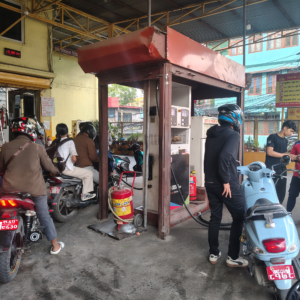
Samuna, 15, and Rakshya, 14, from the Nepali Newsroom report on the impact of the Iran war on Nepali households
US and Israel’s war against Iran may appear to be a distant conflict, but its consequences have quietly made their way into the kitchens of ordinary Nepali families. People throughout the country are feeling the effects of rising prices, a shortage of gas cylinders and more expensive food. The conflict is altering the way Nepalis cook, eat and live.
One of the most significant effects is an increase in the price of essential goods. Nepal, a landlocked country, is surrounded by India on three sides and China on the north. It imports petroleum products from India, and as global oil prices rise as a result of the conflict, so do transportation costs. This makes it more expensive to deliver food to local markets.
Harbingers’ Weekly Brief
Subscribe to the Harbingers’ Weekly Brief, a newsletter written by the editorial board of Harbingers’ Magazine, the world’s youngest newsroom, delivered to your inbox every Monday morning.
![author_bio]()
![author_bio]()


Basic items such as rice, lentils, vegetables and fruit have become more expensive. Many families are now adjusting their budgets and cutting back on specific foods in order to get through the month.
Government rations gas amid shortages
Cooking gas (liquefied petroleum gas, known as LPG), has become a serious problem for Nepali households. The price of gas cylinders (used by most Nepali households) has risen dramatically, and many families can no longer afford to use it freely. Some have switched to electric stoves, while others have reverted to using traditional firewood.
The government has even started rationing gas, which means consumers are not receiving full cylinders anymore.
Instead, many people are getting only half-filled gas cylinders of around 7.1 kg, making daily cooking a real challenge.
Sarita Sarki, 26, who lives in the Mountain Children Home (MCH) in Kathmandu, near a community forest, said that it is very difficult to cook with firewood. “We cook food on fire because we don’t get gas. There is also a shortage of firewood in the jungle. There are strict rules when it comes to collecting firewood. Soldiers often chase us,” she said.
Rajeev and Sanjeev Sah, brothers studying in Kathmandu, had to take a one-day leave to get a gas cylinder. “We have finally received half a cylinder, and in order to receive a cylinder on time, we must provide our name in advance,” they told Harbingers’.
In the interest of saving fuel for commuters, the government of Nepal has implemented a two-day weekly holiday (Saturday and Sunday) in government offices and educational institutions. To make up for lost time, office hours now start at 9am, not 10am.
View this post on Instagram
Nepali workers in the Gulf
Additionally, the war has also put Nepali workers in West Asia (an increasingly common alternative term for the Middle East) at risk.
According to the Ministry of Foreign Affairs, more than 1.7 million Nepalis are currently living in Gulf countries, mainly in the United Arab Emirates (UAE), Saudi Arabia, Qatar and Kuwait. Most are male labourers working on construction projects, but others work in hospitality or domestic jobs.
Around 65,000 young Nepalis leave the country every month for jobs abroad, again mainly to countries in West Asia.
The current conflict in the region threatens their jobs and income. If they lose their jobs or earn less, the money they send back to Nepal will decrease and the lives of their families will become harder.
Nepal’s economy is highly dependent upon such remittances: In 2023, inward remittances exceeded $11 bn, representing roughly 26.6% of GDP, according to official government data.

Harbingers’ Magazine spoke to Partixya B.K., who works as a house help in Dubai, in the UAE. She said that it is very difficult to live there because of the conflict. And there is also the problem of sending money to her family.
In early April, seven Nepalis were injuredin the UAE’s capital, Abu Dhabi, when missile debris fell on them. The Nepali Embassy reported that one person was severely injured, while six were discharged from hospital following treatment.
Nepal’s Ministry of Foreign Affairs has also statedthat 86,420 people have registered their names with the consular services department for rescue. Special flights are being organised to rescue stranded Nepalis.
This conflict has created a big challenge for the new Nepali government. It must take strong steps to control fuel and food prices and ensure that every family in Nepal can afford their daily needs. Overall, the current crisis could lead to severe consequences if the war escalates further.

Edited by:

© 2026 The Oxford School for the Future