


18-year-old Haris explores the relationship between foreign investment and welfare spending in Nepal
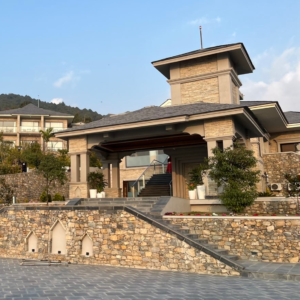
In February, I spent time at the Mountain Children Home in Dadagaun, a small settlement in the hills outside Kathmandu, Nepal’s capital city. A short walk away, in the foothills of Shivapuri Nagarjun National Park, a five-star resort was opening its doors.
The luxury resort – full name Soaltee Resort Shivapuri National Park Kathmandu – has 75 rooms and villas, a glass-walled dining room, banqueting space for 800 guests and views engineered for people flying in rather than driving out. The distance between the children’s home and the resort is a few hundred metres, but the distance between what each represents is much larger.
It is this gap I want to explore.
Harbingers’ Weekly Brief
Subscribe to the Harbingers’ Weekly Brief, a newsletter written by the editorial board of Harbingers’ Magazine, the world’s youngest newsroom, delivered to your inbox every Monday morning.
![slide image]()
![author_bio]()
![author_bio]()


The resort is the fourth Nepal property for the Louvre Hotels Group, which is itself part of the Chinese-owned conglomerate Jin Jiang International, one of the world’s largest hospitality groups. It joins a sister property that opened in nearby Lalitupur in mid-2025, to host conferences, business travellers and diplomatic meetings.
One of the staff at the Shivapuri hotel told me that its guests are mostly business travellers and diplomats. That detail matters – these are not resorts built primarily for Nepalis, or even for tourists chasing the Himalayas. They are built to project an image of Nepal as investment-ready. A stage for capital and diplomacy rather than infrastructure for citizens.
What makes this worth examining is not the hotel itself, but the legal and political road that got it built where it is.
Nepal has spent the last two decades tightening protections around places such as Shivapuri. For instance, hotels inside Chitwan National Park (one of a dozen national parks in the country) were shut down between 2009 and 2012 over ecological and poaching concerns, and for years afterward, development inside or next to protected areas faced real legal resistance.
View this post on Instagram
That changed in April 2024, when the government issued an ordinance that bypassed parliamentary debate, amending the National Parks and Wildlife Conservation Act to open protected areas to commercial infrastructure. The move was timed to coincide with an international investment summit.
Conservation groups, including Nepal’s International Union for Conservation of Nature (IUCN) committee, objected that the government had not consulted anyone before rewriting rules that had been held for decades. The Supreme Court agreed, so in January 2025 it struck down the ordinance.
And yet, barely a year later, a brand-new luxury resort is operating at the foothills of one of the parks that the fight was about. One could argue that the Shivapuri resort sits in Budhanilkantha, in the buffer area rather than the park’s core zone, so it may not have needed the invalidated ordinance at all.
But that is almost the most revealing point. Even without that specific law, the pattern stays the same: permits, land use decisions and diplomatic branding keep tilting toward attracting foreign direct investment and hosting the people who bring it – regardless of which government is in charge or what the courts say about the broader principle. The instinct to say ‘yes’ to this kind of project has outlasted the legal fight over it.

Gen Z protests
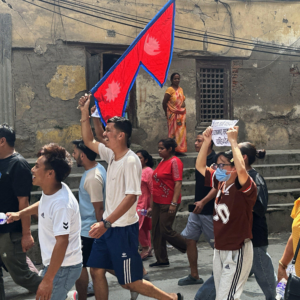
That instinct collided head-on with a very different Nepal in September 2025. What started as anger over a government ban on 26 social media platforms exploded into the largest youth-led uprising in the country’s history.
It fed on something that had been building for years: a movement mocking “nepo kids” (the children of politicians flaunting wealth that looked impossible to explain), while youth unemployment sat above 20% and roughly a third of the country’s economy depended on remittances sent home by Nepalis working abroad.
Within days, parliament and government buildings were burning, Prime Minister K.P. Sharma Oli had resigned, and more than 70 people were dead.
In an unprecedented move, protesters organised on Discord to select an interim leader, choosing Sushila Karki, a former chief justice. She became Nepal’s first female prime minister and oversaw elections in March this year, which the youth-aligned Rastriya Swatantra Party won decisively.
These uprisings and the hotel are not separate stories. They are two answers to the same question: what is Nepali growth actually for?
One answer, embodied by projects like the new Shivapuri resort, treats growth as something you attract from foreign brands, foreign guests, foreign capital, wrapped in diplomatic language about “positioning Nepal” in a competitive regional market.
The other, embodied by the Gen Z uprising, insists that growth has to be felt by the people who never get invited into the banquet hall, the families whose income comes from a relative’s remittance, not a ribbon-cutting ceremony.
Nothing I saw in Nepal suggested the children there were against investment or tourism. What came up again and again in conversation was a much simpler frustration: that the benefits of Nepal’s development never seemed to travel downhill from the capital to places like theirs.
Colleagues of mine, staying in other children’s homes in Nepal on similar humanitarian projects, reported food shortages and a serious lack of resources, with the homes dependent on external support.
That points to an opportunity cost. Nepal’s government has poured political energy into attracting foreign direct investment (FDI), via summits, ordinances and courting global hotel brands. The country’s economic growth has expanded while welfare provision has declined.
A resort built for the international elite can coexist with a fairer economy. The Mountain Children Home where I stayed was asked by the Shivapuri resort if the children wanted to dance and perform small shows for guests.
This small relationship has the possibility to flourish into something even greater where a hotel system and a welfare system work together, helping both institutions grow simultaneously.
However, hotel and resort owners need to step up. In order for Nepal’s social support framework to grow, major corporations have to provide strong support and create a bilaterally balanced relationship rather than an exploitative one.
Perhaps a government willing to ask who a project is actually for before approving it will be the catalyst for change. Yet, on the evidence of the last two years, from courts, protests and ordinances, that question is still very much unresolved.

Edited by:

© 2026 The Oxford School for the Future