

17-year-old Charlotte Wejchert examines the growing impact of AI on language diversity
Did you notice that headline? Delve, intricate, tapestry… If you have spent time online recently or used AI for your writing or learning, these words will definitely feel very familiar or even natural.
While many fantastic writers and orators used many of these words and phrases before AI, there has been an unnatural rise in the use of these words after it. This presents a serious problem.
Language has always been shaped by the people around us and the content we consume. We absorb words and patterns from our environment almost without noticing: a phrase picked up from your friends, a construction borrowed from a book or a new word that enters your vocabulary after you’ve seen it over and over again on TikTok or reels.
For centuries, the dominant inputs were books and articles, then radio, and by the mid-20th century, film and television. Crucially, all of this content was human-made – riddled with stylistic irregularities, personal quirks and the small imperfections that made each novel, speech or news article distinctly human. Language has always reflected society and what was happening in the moment.
This is still accurate today – but maybe our words aren’t fully our own.
View this post on Instagram
What the numbers say
According to a 2025 study by Graphite, a SEO (search engine optimisation) firm, which analysed over 65,000 web articles, 52% of all written content on the internet is now AI-generated.
Graphite claims that AI articles overtook human-written ones in late 2024, with volume more than doubling between 2023 and 2025. So now, the majority of text most people encounter daily has been written by a machine.
This does not only apply to written language. Researchers from Germany’s Max-Planck Institute for Human Development analysed approximately 280,000 transcripts from more than 20,000 academic YouTube channels.
They found that, following the release of OpenAI’s ChatGPT in November 2022, the use of distinctly “GPT-associated” words in spoken, unscripted speech increased significantly: for example, delve by 48%, adept by 51%, realm by 35%. And these are just a few examples of words that we have adopted into our lives, not just in our writing but in our everyday speech too.
Harbingers’ Weekly Brief
Subscribe to the Harbingers’ Weekly Brief, a newsletter written by the editorial board of Harbingers’ Magazine, the world’s youngest newsroom, delivered to your inbox every Monday morning.
![author_bio]()
![author_bio]()


One voice to rule them all!
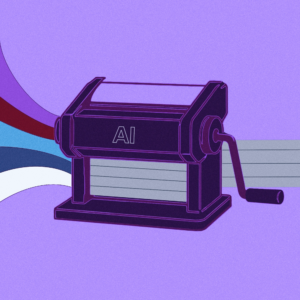
Unlike humans, LLMs (Large Language Models) do not have a style and they don’t produce ‘new’ writing. They work by predicting the statistically most likely next words; producing prose that is the most consistent, most average, essentially the same.
A 2025 study from the University of Southern California (USC) also found that LLM adoption is linked to “notable declines in linguistic diversity”, with models homogenising writing in a way that “selectively amplifies certain dominant characteristics while suppressing others – emphasising conformity over individuality”.

The consequences are already visible in public. In 2025, British politician Tom Tugendhat interrupted a House of Commons debate to accusespeakers from the opposition of reading ChatGPT-generated speeches.
His evidence was the repeated use of “I rise to speak”, an Americanism that ChatGPT defaults to and that has never featured in British parliamentary tradition.
So if the people who are meant to lead us, defend our laws and pass legislation are incapable of thinking and speaking with their own ideas, what does it mean for us?
What’s at stake
When we consume AI-generated content and over time adopt the language and start to use it more and more, then the data (produced by us influenced by AI) used to produce its outputs feeds off the same words, creating a loop.
Researchers at USC describe this as a “recursive feedback loop” in which homogenisation transforms “from a passive bias into a structurally reinforced influence”.
The Ada Lovelace Institute in London adds that the training data skews heavily towards Western, English-language, high-income norms meaning that the “voice” that is being normalised is inherently not neutral.
So what do we risk losing? Our idioms, our mannerism, our mistakes – the very things that make our language our own.
But there is also a question of what we may gain: AI could, in theory, give any writer access to a rich vocabulary and complex structures previously available only to the highly educated. It can lower barriers to entering competitive jobs, gaining skills and learning, but it can also have negative effects on our brains.
So where does this leave us? Do we rebel against the status quo and abstain from using AI? Or will we fall behind the curve if all our peers and competitors are using it?
There isn’t a clear answer but being aware that this is happening is already a strong start. And a healthy dose of reading a good old-fashioned book and writing without the help of AI definitely won’t hurt.

Edited by:

© 2026 The Oxford School for the Future