


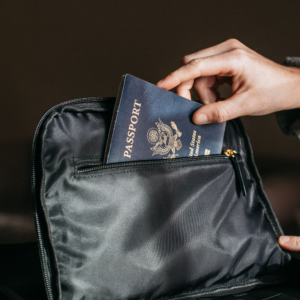
16-years-old Mane from the Armenian Newsroom explains how passport privilege shapes global mobility in 2026
We don’t choose where we are born, but our birthplace completely decides how much of the world we are allowed to see.
Imagine that you’re born in Singapore. You can hop on a plane to almost any country, but if you’re born in Afghanistan, you can barely cross a single border without months of paperwork and expensive visa interviews.
The latest Henley Passport Index, published in January, reflects a shifting global balance of influence. The old rule where holding the passport of a Western economic superpower automatically meant you could travel anywhere doesn’t really apply anymore.
Harbingers’ Weekly Brief
Subscribe to the Harbingers’ Weekly Brief, a newsletter written by the editorial board of Harbingers’ Magazine, the world’s youngest newsroom, delivered to your inbox every Monday morning.
![author_bio]()
![author_bio]()


What is the Henley Passport Index?
The Henley Passport Index was created by Henley & Partners, a residence and citizenship advisory firm.
First published in 2005 under a slightly different name, it was rebranded to the Henley Passport Index in 2018. It is updated monthly to reflect any new visa laws or political changes.
The index covers 199 passports and 227 travel destinations and is based on data from the International Air Transport Association (IATA), supplemented by analysis from Henley & Partners. Passports are ranked by the number of destinations their holders can enter without needing a visa.
Which country has the strongest passport?
Singapore currently holds the world’s strongest passport. Singaporean citizens can travel to 192 destinations, without obtaining a visa in advance, including many that offer visa-free or visa-on-arrival access.
Japan, South Korea, and the United Arab Emirates (UAE) share second place, each with access to 188 destinations. Then come a large number of countries in the European Union (186 destinations). The UK, no longer in the EU, is sixth (184 destinations).
View this post on Instagram
Which country has the weakest passport?
Afghanistan is at the bottom of the index. Afghanistani citizens can only enter 23 countries without getting a visa in advance, most of them being small island nations or countries in sub-Saharan Africa and Asia. Countries experiencing prolonged conflict or political instability typically have weaker passports because other states impose stricter entry requirements.
Other countries with the weakest passports include Syria, Iraq, North Korea and Bangladesh. Pakistan is also close to the bottom at 100th, with just 30 visa-free destinations. Perhaps surprisingly, Iran is higher, placed 95th, with 36 destinations.
North Korea is tied with Bangladesh at 96th place, with visa-free or visa-on-arrival access to just 36 destinations.
Why is the UAE so high?
The UAE’s meteoric rise is the biggest success story in global travel history. Over two decades, its passport has climbed an unprecedented 57 places to surpass heavyweights like the US and UK.
This didn’t happen by accident: the UAE treats visa-free travel like a business deal, systematically trading for access rather than just asking for it.
Their masterstroke came in 2015 by securing an EU Schengen visa waiver, a milestone they quickly leveraged for bilateral deals across Latin America, Africa and Asia.
Today, this diplomatic strategy grants Emirati citizens unmatched mobility, providing visa-free or visa-on-arrival access to 188 destinations worldwide, including 127 completely visa-free, 45 with a visa-on-arrival and 10 via electronic travel authorisation.
Why is US passport power stagnating?

The US is stuck in a major passport rut. Back in 2014, it had the number one passportin the world, but today it’s drifted down to 10th because global diplomacy is a two-way street.
Since the mid-2010s, the US has been hyperfocused on border security, keeping its visa process slow and complicated for foreigners. This has created a massive gap, Americans can visit 180 countries visa-free, but the US allows only46 nationalities to enter visa-free.
Some countries, including Brazil, have reintroducedvisa requirements for American travellers, reflecting a greater emphasis on visa reciprocity.
By maintaining relatively restrictive entry policies while other countries expand visa agreements, the US has seen its passport lose ground in the global rankings.
How to tackle passport privilege?
Passport privilege is something most people never think about until they experience its absence. If you hold a strong passport, you should recognise that the freedom to travel is an advantage that millions of people do not share.
So-called “golden visa” programmes reveal another layer of passport privilege, for wealthy people, mobility can often be bought through investment-based residency or citizenship schemes.
Raising awareness of the long waiting times, high costs of visas and uncertainty faced by people with weaker passports is one way to highlight one of the world’s least discussed forms of inequality.

Edited by:

© 2026 The Oxford School for the Future