

17-year-old Tomasz examines what the US’s stake in a Venezuelan oil company reveals about how Trump does business
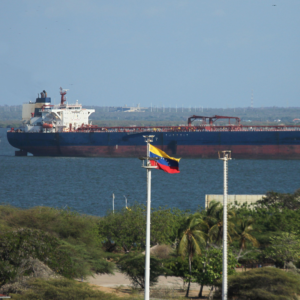
On 31 August, the White House published the terms of what President Donald Trump had announced as “the biggest oil deal in world history”. The details turned out to be stranger than the slogan.
According to a White House fact sheet, Venezuela’s interim government, led by Delcy Rodríguez, has granted 100-year concessions to 17 oil fields to North American Blue Energy Partners. NABEP is a privately held company registered in Barbados and run by a Venezuelan businessman, Alejandro Betancourt. The fields hold roughly 65 billion barrels – about a fifth of Venezuela’s proven reserves, and more oil than the United States holds in its proven reserves.
NABEP has handed the Pentagon’s Office of Strategic Capital a 35% equity stake in its parent company. The State Department can buy a fifth of everything NABEP produces at the cost of production, and holds first refusal on the remaining 80%. Washington also has a veto over the appointment of NABEP’s directors, a majority of whom must be US citizens. The contract is governed by American law and American courts.
In return, Venezuela, is promised up to $100bn of investment in oil structure and thousands of jobs.
The United States government is now a shareholder in the company, the writer of its rules, first in line to buy its oil, and the guarantor of its contract – all at the same time.
The partner it chose is not a conventional oil executive. Alejandro Betancourt, 46, built his fortune on contracts to construct power stations during the electricity crisis under Hugo Chávez’s presidency of Venezuela.
Over the past decade, he has been investigated in Switzerland, Spain and the US over alleged money laundering, including his suspected part in a scheme that US prosecutors say drained more than $1bn from the state oil company PDVSA. He has never been charged in any of the three countries, and denies any wrongdoing.
Swiss prosecutors even wanted him arrested. They asked the US Justice Department to detain him, but instead he was granted a multi-entry visa and travelled repeatedly to the US to work on the oil deal, after senior American officials intervened in the Swiss case.
CNN has reported that prosecutors in Miami closed their own long-running investigation into him as the agreement took shape. Secretary of state Marco Rubio has defended the partnership, noting that Betancourt faces no open investigations in the US. The Justice Department denies that its leadership intervened in closing the Miami investigation.
Harbingers’ Weekly Brief
Subscribe to the Harbingers’ Weekly Brief, a newsletter written by the editorial board of Harbingers’ Magazine, the world’s youngest newsroom, delivered to your inbox every Monday morning.
![author_bio]()
![author_bio]()


Secret arrangement
The arrangement looks exotic; however, it is not isolated. Since January 2025, the US government has announced 48 deals worth $30.3bn that involve taking direct ownership of private companies, most of them in the US. The Department of Commerce accounts for 24 of them, the most significant one being a 10% stake in the chipmaker Intel. The Department of Defense has disclosed 13 such deals.
What has changed is the instrument. Rather than paying a company to behave in a particular way, Washington is buying a piece of the company and sitting on the other side of the table. The idea is old enough to have been rejected before: Congress came close to creating a federal oil company in 1976, but the vote narrowly failed.
Venezuela is where this idea might come to life. The other stakes are in firms operating mostly on US soil, under US regulators, employing US workers. This one is in a company whose fields, payroll and tax bills sit in a country that US forces reshaped by force eight months earlier.
View this post on Instagram
The administration’s case is about supply. American emergency oil reserves are depleted and prices have soared after Iran closed the Strait of Hormuz because of the US and Israeli attacks. Energy secretary Chris Wright has said that the government’s involvement reassures companies otherwise unwilling to operate in Venezuela, and that the arrangement is not a replacement for private firms.
Congress was not shown the contract. On 20 September, five Democrats from the House of Representatives demanded to see the full text, after a closed briefing left members of both parties dissatisfied, and raised the prospect of subpoenas. They did not get it from the government.
On 20 October, ProPublica published what it reported was the 18-page agreement, signed by Marco Rubio, defence secretary Pete Hegseth, Betancourt and one of his executives. The text shows Washington paying a cent a share for its stake, Betancourt protected as chief executive, disputes kept out of Venezuelan courts, and the $200bn in royalties and taxes promised to Venezuela nowhere explicitly guaranteed.
People involved in the negotiations told ProPublica it had been built so that no future American administration or Venezuelan government could unpick it. That is what the state as shareholder turns out to mean. Buying into a company is not simply taking a position in a market. It is tying the hands of whoever governs next.

Edited by:

© 2026 The Oxford School for the Future