Harbingers’ Magazine is a weekly online current affairs magazine written and edited by teenagers worldwide.
harbinger | noun
har·bin·ger | \ˈhär-bən-jər\
1. one that initiates a major change: a person or thing that originates or helps open up a new activity, method, or technology; pioneer.
2. something that foreshadows a future event : something that gives an anticipatory sign of what is to come.
We and our partners may store and access personal data such as cookies, device identifiers or other similar technologies on your device and process such data to personalise content and ads, provide social media features and analyse our traffic.
I started picking at my skin when I was 13 years old, and I’m still working on overcoming it.
While skin picking continues to take a toll on my mental health and well-being, it has also taught me valuable lessons that extend far beyond knowing which skin products to use.
Skin picking disorder, also known as dermatillomania, is a mental health condition that leads to repetitive and compulsive skin picking, scratching and squeezing. It can cause wounds, scarring and infections, as well as emotional distress and isolation.
At first, though, I didn’t think of it as a disorder. I saw it merely as a bad habit.
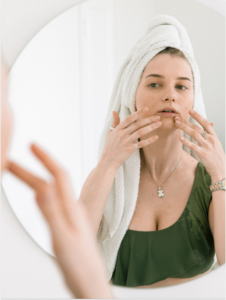
Desperately trying to fix my skin’s uneven texture and minor flaws, I would stand in front of my bathroom mirror everyday and pick at my face until it was covered in visible scars and wounds.
Looking at my reflection afterwards, I felt ashamed, disappointed and even disgusted with myself.
Even worse was the healing process, as it often took weeks for my skin to fully recover. Not only was it challenging to resist the urge to pick at my skin again, but I also struggled with the thought of how others might perceive me with unhealed scars all over my face.
“Why do I keep doing something that single-handedly destroys both my skin and my confidence?” I remember thinking.
By that time, my mom had already told me multiple times that I have to immediately stop picking at my skin. She explained that otherwise it can have permanent consequences, such as hyperpigmentation on my face. Even though I understood the possible outcomes, I still couldn’t refrain from skin picking.
I spent hours and hours scrolling through TikTok videos, trying to find any useful suggestion on how to overcome this harmful behaviour. No matter whether the advice was to turn off the bathroom lights, limit the amount of time I spent in front of my mirror, or put on pimple patches, nothing seemed to help.
Soon, I began to realise that what I once believed was purely a bad habit might be part of a broader and more complex issue.
Harbingers’ Weekly Brief
Subscribe to the Harbingers’ Weekly Brief, a newsletter written by the editorial board of Harbingers’ Magazine, the world’s youngest newsroom, delivered to your inbox every Monday morning.
See you on Monday!
Ooops - please try again.
Skin picking is particularly widespread among young people. According to a 2025 survey of teenagers who reported “body-focused repetitive behaviours” such as hair pulling and nail biting, nearly a third engage in skin picking. Girls are affected the most.
Treating dermatillomania often involves more than healing the skin, as the disorder is frequently triggered by stress, perfectionism and loss of control. Therefore, when struggling with a skin picking disorder, visiting a therapist is highly recommended.
For me, going to therapy has completely transformed the way I look at skin picking. It made me understand that the first step to deal with this complex issue is to be more forgiving towards myself.
This journey forced me to confront my perfectionism, as I began to recognise that neither my life nor my face needs to be spotless for me to be enough.
Through practising self-acceptance I also learned that progress is never linear and that gradual change without immediate improvement can still be considered success.
My path towards healing is far from being over. However, one of the most important lessons it taught me is not to be afraid to ask for help.
If you find yourself repeatedly picking at your skin, even when you desperately want to stop, don’t dismiss it as just another bad habit. Talk to someone you trust, and don’t be scared to reach out for professional help.
Remember that you’re not alone. Many young people deal with skin picking, but that doesn’t make your struggles less deserving of attention and support.
Born in 2008 in Budapest, where she still lives and studies, Viola is interested in journalism, pop culture, international relations and psychology.
In her free time, she plays piano, dances and enjoys daydreaming while listening to music. She also loves taking long walks in the countryside with her dogs.
Viola speaks English, Hungarian, French and German.
🌍 Join the World's Youngest Newsroom—Create a Free Account
Sign up to save your favourite articles, get personalised recommendations, and stay informed about stories that Gen Z worldwide actually care about. Plus, subscribe to our newsletter for the latest stories delivered straight to your inbox. 📲
We use cookies to ensure that we give you the best experience on our website. If you continue to use this site we will assume that you are happy with it.