


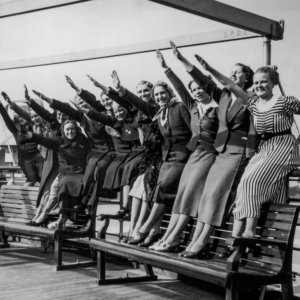
17-year-old Nell explores women’s place in German society before and during the Nazi era
Before the First World War, women in Imperial Germany were subjected to the patriarchal structures typical of the time. Class divides meant that women’s experiences varied considerably. Upper-class women were expected to conform to strict feminine ideals, while working-class women were more likely to work outside the home as Germany’s industrialising economy demanded more labour.
The First World War changed women’s place in the workforce. They were no longer limited to jobs traditionally considered suitable for them and increasingly moved into industries previously dominated by men, including arms production.
In August 1914, Germany’s main arms manufacturer Krupp “employed only 963 women out of a total workforce of 41,764. By mid-1917, the workforce had tripled in size, and one-quarter, 28,664 in total, were women,” writes American historian Eric D. Weitz in his book Weimar Germany: Promise and Tragedy (2007).
Harbingers’ Weekly Brief
Subscribe to the Harbingers’ Weekly Brief, a newsletter written by the editorial board of Harbingers’ Magazine, the world’s youngest newsroom, delivered to your inbox every Monday morning.
![image]()
![image]()
![author_bio]()


But this did not mean equality. Women were generally paid less than men, and at the end of the war many were expected to give up their jobs to returning soldiers.
Political change came quickly after Germany’s defeat. In November 1918, women were allowed to vote and stand for election. They took part in a national election for the first time on 19 January 1919: 82% of eligible women voted, and 37 women were elected to the Weimar National Assembly.
The Weimar Republic brought a significant expansion of women’s political rights, but representation remained limited. Women made up less than 9% of the National Assembly elected in 1919, and their representation later declined. The Bundestag (Germany’s current parliament) notes that women remained a small minority in parliament throughout the Weimar period.
How did women vote?
The 1920s also saw visible changes in social norms. Women, particularly in cities, were no longer always expected to marry immediately after leaving their parents’ homes. The image of the Neue Frau (“new woman”) became associated with paid work, independence, smoking, nightlife and, in terms of fashion, short, tubular dresses.
But the image of the independent young woman in Berlin did not represent all German women. Many remained politically and socially conservative, and voting patterns were strongly influenced by class, religion and geography.
View this post on Instagram
Despite the progressive nature of the Weimar constitution, it would be wrong to assume that women overwhelmingly supported moderate or left-wing parties. Although the SPD (Social Democratic Party) had supported women’s suffrage since the 19th century, that did not give it the electoral advantage it might have expected.
Research into voting during the Weimar Republic shows that women tended to vote more heavily for religious and conservative parties than men did, particularly the Catholic Centre Party and the Protestant-aligned German National People’s Party (DNVP).
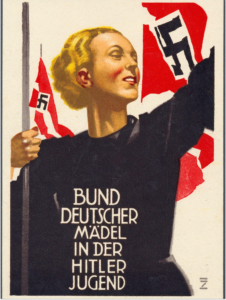
However, women were less likely than men to vote for Hitler’s Nazi Party (NSDAP). Research shows that throughout most of the Weimar Republic, the Nazi Party attracted significantly more male than female support. But that started to change in the early 1930s, especially in Protestant areas.
“By July 1932 the NSDAP was winning a higher percentage of the female to male vote. In that month, some 6.5 million women voted Nazi, many of them probably with few or no previous political ties,” according to British historian Dick Geary.
This raises an uncomfortable question. Why would millions of women who had gained significant political rights only a little over a decade earlier support a party that promoted a far more traditional role for women?
Depression, fear and political collapse
Part of the answer lies in Germany’s economic crisis. The Great Depression (1929–34) following the Wall Street Crash hit Germany particularly hard, because its economic recovery during the 1920s had become heavily dependent on foreign investment and American loans.
By 1932, some 5.6 million Germans were officially unemployed, while industrial production had fallen by roughly 40% compared with 1928. There was visible poverty, insecurity and growing political instability. Families struggled to pay rent and buy food, while workers who kept their jobs often faced cuts in wages and hours.
Women were often overlooked in unemployment figures, because many did not register with the authorities after losing their jobs, so the real number of people affected by unemployment was higher than the official figures suggest.
Like many men, women increasingly felt that the existing political system had failed them. The Nazis were highly effective at turning that frustration into political support. They promised jobs, order and national revival while blaming Germany’s problems on democratic politicians, communists and Jewish people.
They also deliberately targeted women in their campaigning. A Nazi election poster from 1932 preserved by the United States Holocaust Memorial Museum declared: “We women are voting National Socialist.”
Economic desperation was not the only reason women supported the Nazis. Religion, nationalism, anti-communism, antisemitism and distrust of democracy also mattered. Women who had previously supported conservative parties could move towards the Nazis as the political right itself became more radical.
Women at the heart of Nazi ideology
Some women also supported the Nazis for ideological reasons. Nazi racial propaganda gave women a central role, portraying so-called “Aryan” and “racially pure” women as mothers whose duty was to produce and raise children for the German nation.
Women were not simply being told to stay at home. They were assigned a specific role within the Nazis’ racial and political project.
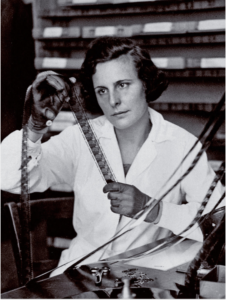
Prominent women associated with the Nazi movement included Gertrud Scholtz-Klink, who led the National Socialist Women’s League, and film director Leni Riefenstahl, whose films became closely associated with Nazi propaganda. Wealthy socialites Helene Bechstein and Elsa Bruckmann were also early supporters of Hitler and helped introduce him into influential conservative social circles.
Once the Nazis came to power in 1933, they introduced policies designed to encourage marriage and childbirth. The 1933 Law for the Encouragement of Marriage offered newly married couples generous loans of up to 1,000 Reichsmarks. Women receiving the loans were expected to leave paid employment, and the amount couples had to repay was reduced as they had children.
At the same time, Nazi attitudes towards women were not always consistent in practice. The party promoted the ideal of women staying at home with their children, but Germany’s rearmament programme increasingly required female workers.
The Holocaust Encyclopedia notes that rearmament and then total war forced the Nazi regime to move away from its ideal of women remaining solely in the home. Women were increasingly drawn into the workforce and later into military auxiliary roles.
Women were not only victims
It is tempting to look at Nazi policies towards women and assume that women could only have been victims of the regime. That is too simple.
Women were certainly restricted under Nazism, but they were also capable of supporting and participating in the system. Around 13 million German women were active in Nazi Party organisations.
They worked as teachers, nurses, welfare workers, secretaries and auxiliaries. Some also participated directly in persecution and mass violence, including as guards in concentration camps.

This does not mean that German women as a group brought Hitler to power. In fact, the available voting evidence does not support the claim that women were responsible for Hitler’s electoral success. For most of the Weimar period, men were more likely than women to vote for the Nazis.
Nor was Hitler simply voted into power. The Nazi Party became the largest party in the Reichstag in 1932 but did not win an outright majority in a free national election. Hitler was appointed chancellor by the President Von Hindenburg on 30 January 1933.
Still, by 1932, millions of German women had voted for the Nazi Party. Their reasons varied. Economic insecurity and political instability mattered, but so did religion, nationalism, antisemitism, anti-communism and the appeal of Nazi propaganda. Women could be restricted by the system and still support it. Some could also become active participants in it.

© 2026 The Oxford School for the Future