Harbingers’ Magazine is a weekly online current affairs magazine written and edited by teenagers worldwide.
harbinger | noun
har·bin·ger | \ˈhär-bən-jər\
1. one that initiates a major change: a person or thing that originates or helps open up a new activity, method, or technology; pioneer.
2. something that foreshadows a future event : something that gives an anticipatory sign of what is to come.
We and our partners may store and access personal data such as cookies, device identifiers or other similar technologies on your device and process such data to personalise content and ads, provide social media features and analyse our traffic.
In history, after a terrible crime takes place, it is crucial to remember its importance.
This is why it is also important for societies to select a suitable name that will be used for centuries.
The term “Holocaust” appeared for the first time in the mid-1940s. It originated from the Greek term holokauston, which describes a “completely burned sacrificial offering”. It referred to a religious sacrifice that involved completely burning the altar.
Historically, the word referred to any widespread destruction. The shift to indicate Nazi actions against Europe’s Jewish population during the Second World War started being widely popularised in the 1950s. But why did it take so long to start using an actual term instead of “the Destruction of the European Jews”, which appears rather technical?
After any historical event, the name for it is shaped by historians, writers and journalists long after the dust settles. They are established using metaphors and symbols. For example, the name “Holodomor” literally means “sea of hunger”. The Holodomor was the great famine in Ukraine in 1932–33, caused by the Soviets. It resulted in more than four million deaths throughout the country.
Harbingers’ Weekly Brief
Subscribe to the Harbingers’ Weekly Brief, a newsletter written by the editorial board of Harbingers’ Magazine, the world’s youngest newsroom, delivered to your inbox every Monday morning.
See you on Monday!
Ooops - please try again.
After the genocide in Rwanda in 1994, in which close to a million people were killed in 100 days, teachers in the country were not allowed to discuss it with their pupils for ten years. It was added to the curriculum in Rwanda only in 2008. The reason behind this decision was to not trigger animosities surrounding fresh and delicate history that touched many students and their families.
Similarly, the Holocaust gradually started appearing as a subject in school, from the late 1970s to the 1990s. As was the case later in Rwanda, the Holocaust was not part of education for many reasons: the wounds were still fresh, survivors were still scared, and the world was more focused on moving forward than looking back into its often shameful past.
Effectively, the word Holocaust did not appear for many years. The silence surrounding the enormity of the actions of the Nazis and their collaborators needed time to be processed, defined and named.
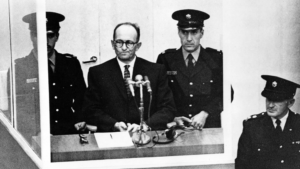
The word “Holocaust” (with a capital H) began being used without qualification to specifically mean the Nazi genocide during the 1961 trial of Adolf Eichmann in Jerusalem.
It was also popularised through books and TV. The 1978 TV series Holocaust, starring Meryl Streep, helped to bring the word to life. The famous 1985 documentary Shoah, directed by Claude Lanzmann, also played a crucial role in bringing attention to the Holocaust worldwide.
But “Holocaust” is not the only term. “Shoah” – meaning “destruction” or “ruin” – is the word used by Hebrew-speaking Jews. In Polish, “Zagłada” (“doom”) describes the annihilation of European Jews. But there are other words and phrases; some simply use “the massacre” or “the European catastrophe”.
It is also not the only word that came to existence in the wake of the Holocaust. In 1944, a Polish Jewish lawyer named Raphael Lemkin realised that there was no legal term referring to the destruction of a specific ethnicity. This led to him to create the word “genocide”, which became the main legal and political term used in international affairs.
The full definition of genocide was established in 1948, when the United Nations agreed the Convention on the Prevention and Punishment of the Crime of Genocide. It states that for a genocide to happen, three main aspects have to be present: killing or causing serious bodily/mental harm to members of a particular group; inflicting conditions of life meant to cause physical destruction; and preventing births or forcibly transferring children.
Today, the history of genocide, and especially the Holocaust, is a compulsory topic in most Western schools. Young people need to learn about the Holocaust and what led to it because those who set the school curricula hope that this will make them aware of the past and, most importantly, able to distinguish between good and evil.
Marian Turski, a Polish journalist, historian and Holocaust survivor, said: “Auschwitz did not fall from the sky”. In order for such events to not happen again, people need to discuss and explore what took place – and knowing the correct words and where they came from is the beginning of that journey.
Film & Book Club Editor and Global Newsrooms Manager
Warsaw, Poland
Klara Hammudeh, born in 2008 in Warsaw, Poland, joined Harbingers’ Magazine in March 2024, writing on international affairs, crime and music.
Since joining the magazine, she has published numerous articles on politics and culture. In 2024, she reported on the US presidential elections on the ground, and in February 2025 covered the Middle East crisis from Amman, Jordan. Her strong writing and editorial work led to her appointment as Politics Section Editor in March 2025, while also serving as Poland’s 2025 Presidential Election Newsroom Editor. During her time in this role, she also reported on the ground on Zohran Mamdani’s appointment as Mayor of New York.
In 2026, Klara continues as Politics Section Editor and also takes on the roles of Film & Book Club Editor and Global Newsrooms Manager, helping coordinate Harbingers’ international reporting initiatives.
Klara attends high school in Warsaw, Poland. She plans to study psychology, international politics or criminology, preferably in the United States.
In her free time, she enjoys reading, dancing, listening to music and exploring pop culture — particularly how Broadway and the West End adapt classic Disney stories into musicals.
2026 special newsroom
🌍 Join the World's Youngest Newsroom—Create a Free Account
Sign up to save your favourite articles, get personalised recommendations, and stay informed about stories that Gen Z worldwide actually care about. Plus, subscribe to our newsletter for the latest stories delivered straight to your inbox. 📲
We use cookies to ensure that we give you the best experience on our website. If you continue to use this site we will assume that you are happy with it.