Harbingers’ Magazine is a weekly online current affairs magazine written and edited by teenagers worldwide.
harbinger | noun
har·bin·ger | \ˈhär-bən-jər\
1. one that initiates a major change: a person or thing that originates or helps open up a new activity, method, or technology; pioneer.
2. something that foreshadows a future event : something that gives an anticipatory sign of what is to come.
We and our partners may store and access personal data such as cookies, device identifiers or other similar technologies on your device and process such data to personalise content and ads, provide social media features and analyse our traffic.
Ever notice how the movies we consume today seem so similar to each other?
A quick trip down the box office from the last couple of years reveals an obvious pattern: Snow White, Aladdin, Harry Potter, The Hunger Games and many more are being revived.
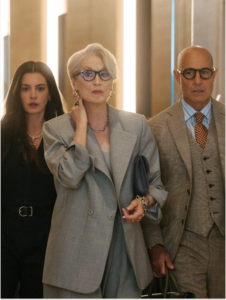
This year, the Devil Wears Prada 2, Toy Story 5 and Spider-Man: Brand New Day movies are expected to bring in millions of dollars.
The result? Many people are tired of the repeats and remakes that crawl their way from our childhood to the silver screen.
Personally, as someone who grew up watching the Percy Jackson and Harry Potter films, there is a sense of untouchable nostalgia related to those franchises that has been compromised because of the multitude of remakes.
Hollywood continues to rely on nostalgia and pre-existing intellectual property as a ‘safe bet’.
In an extremely uncertain environment, movie studios know that banking on sequels and adaptations almost guarantees a baseline audience, unlike taking a creative risk that may draw in very few people.
According to a 2024 US survey conducted by streaming platform Tubi in collaboration with Harris Poll, 73% of Gen Z viewers express a preference for original content over remakes. So the real question is why do movie studios continue to push out films that the public clearly does not want?
The answer is that the hearts of the audience as well as success at the Oscars are often secondary in the minds of major studios. Films that dominate the awards circuit may be original and stylistically bold, but they rarely match the massive box office returns of blockbusters. For Hollywood, critical acclaim rarely matches profit security.
Harbingers’ Weekly Brief
Subscribe to the Harbingers’ Weekly Brief, a newsletter written by the editorial board of Harbingers’ Magazine, the world’s youngest newsroom, delivered to your inbox every Monday morning.
See you on Monday!
Ooops - please try again.
This creates a widening divide between what is artistically valued and what is prioritised. Original films such as Anora (2024) or Everything Everywhere All at Once (2022) may be groundbreaking and receive critical praise, but they often lack the marketing power that large franchises command. Recognisable titles such as Avengers or Toy Story arrive with decades of built-in loyalty.
While viewers frequently express frustration with the repetitive storytelling Hollywood churns out, the viewing habits of audiences show that viewers often continue to perpetuate the same cycle they criticise. Nostalgia remains incredibly powerful, and audiences still continue to show up even if they agree that the original is better.
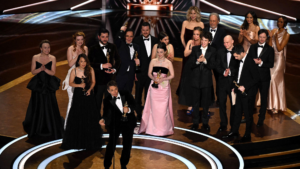
Director Sean Baker accepts the Best Picture award for ‘Anora’ at the 2025 Academy Awards.
Despite the fact that Hollywood is dominated by big studios, there are some exceptions and modern filmmakers continue to push for a new standard.
A24, an independent American entertainment company that has released big films such as Hereditary (2018), Marty Supreme (2025), and The Drama (2026), has shown that originality and invention can go hand in hand with profit. They also cast A-list actors, such as Timothee Chamalet and Zendaya, which no doubt brings attention and a larger audience.
However, as David Offenberg, professor of entertainment finance at Loyola Marymount University, commented: “They’re never in a position where they hit a home run and make hundreds of millions of dollars on a title. They’re taking small bites of profit.”
A24 films often have budgets of $15m to $20m and do not spend much on marketing. In comparision, the average budget for a Hollywood film in 2022 was $77m, while budgets for big studio blockbusters can range from $150m to well over $300m.
For a studio that prioritises experimentation and boundary pushing, A24’s cultural impact reaches far beyond its budgets. Lady Bird (2017) and Everything Everywhere All at Once, which earned $78m and $100m respectively worldwide, are not box office breakers by any means, but they represent a growing audience hungry for inventive films.
It is increasingly important to keep cinema alive as the use of AI increases . While AI can revolutionise filmmaking through editing and visual effects, its growing role in script writing,camerawork and editing also threatens creative work in cinema. If Hollywood continues to push down unique ideas, the creative future of filmmaking may become endangered.
A24’s success demonstrates that film studios should prioritise risk rather than recycled ideas and familiar formulas. Originality is what shapes the movie industry at its core, and genres from 50 years ago do not match what we watch today because studios continue to evolve through invention.
If major companies continue to regurgitate what has been released before, cinema risks becoming stagnant. Give inventive films a chance.
Stephanie Kwok, born in 2009 in Hong Kong, joined Harbingers’ Magazine in November 2025 as the overall winner of the Harbingers Prize 2025. After completing the writing course, she became a regular writer for the magazine.
Her strong writing and editorial engagement led to her appointment as South Asia Editor for 2026, a role she took up on 1 March. In this position, she helps coordinate reporting and contributions from the region.
Stephanie lives and studies in Hong Kong and is an aspiring journalist and writer. She is particularly interested in investigative journalism, English literature and classics.
She is also a contributing writer for several publications, including Polyphony Lit and FilmPsych, and enjoys writing poetry in her free time.
Stephanie speaks English, Cantonese, Mandarin and Shanghainese, and is currently learning Latin.
🌍 Join the World's Youngest Newsroom—Create a Free Account
Sign up to save your favourite articles, get personalised recommendations, and stay informed about stories that Gen Z worldwide actually care about. Plus, subscribe to our newsletter for the latest stories delivered straight to your inbox. 📲
We use cookies to ensure that we give you the best experience on our website. If you continue to use this site we will assume that you are happy with it.