



Harbingers’ Magazine is a weekly online current affairs magazine written and edited by teenagers worldwide.
harbinger | noun
har·bin·ger | \ˈhär-bən-jər\
1. one that initiates a major change: a person or thing that originates or helps open up a new activity, method, or technology; pioneer.
2. something that foreshadows a future event : something that gives an anticipatory sign of what is to come.
We and our partners may store and access personal data such as cookies, device identifiers or other similar technologies on your device and process such data to personalise content and ads, provide social media features and analyse our traffic.
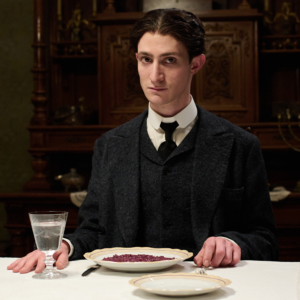
Agnieszka Holland’s new film, entitled simply Franz Kafka, takes on the challenging task of portraying the life of a famously complex writer.
The film isn’t a standard biography – Holland captures a figure suffocating in trying to accomplish competing duties, torn between an obligation towards an authoritative father and the need to follow his loud inner voice.
Kafka (played by Idan Weiss) emerges as a man burdened by fear and self-doubt, yet also marked by a rare capacity for sensitivity and creativity. Tomasz Naumiuk’s cinematography plays a key role here: it pulls the audience right inside Kafka’s world, making the story feel relatable beyond its historical setting.
What stands out is Holland’s willingness to show Kafka not as a distant genius but as a restless, often isolated individual struggling with contradictions. He’s at once sensitive and emotionally raw, but also possesses a literary vision that was ahead of his era. The film balances a close, intimate portrait with a wider historical background.
In this way, it becomes more than just a period piece; it’s a reflection on internal conflict and alienation that still rings true, particularly to younger viewers trying to shape their identities in a confusing world.
For those who struggle with socialisation, the film might hit a particular chord. It speaks to the sense of searching and uncertainty that often accompanies youth, making Kafka’s struggles feel less like historical facts and more like a personal journey. Holland builds an atmosphere that combines intimacy with artistic depth, drawing viewers in while leaving room for sensitivity and emotions.
We found the film quite compelling when it comes to the production. The acting – strong all around – stands out, and the camerawork is equally effective in creating a sense of admiration in the audience. However, some elements did feel a bit unresolved or were left hanging. For instance, the narrative thread about a male-only care home was quite confusing; we couldn’t understand whether it was a metaphor for Kafka’s life, or actually took place.
Visually, the film is striking. Holland uses colour, light and shadow with care to convey the mood of Kafka’s inner world. Often, the colours are muted or even dull, reflecting the monotony and alienation that Kafka experienced in his everyday life. Then, at other moments, flashes of light and darkness hint at his imaginative and emotional complexity.
Kafka is not painted as a mythic figure. Instead, he comes across as a man full of contradictions – delicate and tormented but also driven by an intense urge to create.
This approach makes the film feel less like a grand monument to a literary giant and more like a human portrait of an outsider struggling with both his mind and the society around him.
One of the most significant elements of Franz Kafka is how strongly it reflects the idea of the “Kafkaesque”, a term derived from the author’s surname that is used to describe feelings of oppression, absurdity and being trapped in systems that cannot be fully understood.
The film illustrates this concept via mood, space and emotion rather than explaining it directly – confined interiors and distant authority figures create a sense of quiet anxiety similar to what readers experience in Kafka’s novels. His struggle with power, duty and guilt are often reflected in his works, including The Trial and Metamorphosis.
Harbingers’ Weekly Brief
Subscribe to the Harbingers’ Weekly Brief, a newsletter written by the editorial board of Harbingers’ Magazine, the world’s youngest newsroom, delivered to your inbox every Monday morning.
See you on Monday!
Ooops - please try again.
The line between reality and personal fear often feels blurred, making both viewer (and reader) question whether Kafka is imprisoned more by society or by his own mind. In this way, the film does not only portray Kafka – it is also a key to the emotional logic behind his literature.
Looking ahead, Franz Kafka may also suggest a clear direction in Holland’s future movies. She continues to portray complex individuals caught between personal freedom and outside pressure, often set against a broader historical or political background. Think of Green Border (2023), Spoor (2017), In Darkness (2011), all the way back to Europa, Europa (1990).
If this trend continues, her upcoming projects are likely to focus less on action itself, but more on psychological depth and moral ambiguity. Holland’s cinema seems to be focused on asking questions rather than providing answers. This consistent interest in human nature has become a recognisable signature of her work.
In the end, Franz Kafka is a film that values emotional truth over easy storytelling. It avoids turning its protagonist into an immortal legend and instead presents him as a sensitive, fractured individual searching for a meaning. Through different effects such as quiet tension, careful visuals and psychological depth, Holland delivers not just a portrait of a writer, but a reflection on loneliness, (Kafkaesque) fear and the need to create.
Born in 2009 in Warsaw, Poland, Kaja joined Harbingers’ Magazine to write about and share the beauty of film, photography and literature.
Her plans for the future are to study international relationships, psychology in business, or working in film production – she aspires to progress in directions where she could be truly proud of what she is doing.
In her spare time she enjoys discovering and reviewing good films, reading philosophical books, designing art, cooking and baking. She likes to be active in any type of sport, mainly volleyball and snowboarding.
Born in 2008 in Warsaw, Poland, Mikołaj joined Harbringers’ Magazine to focus on coverage of the presidential elections in Poland.
In the future, he aspires to study finance or economics, preferably somewhere in Europe. His primary goal is to achieve financial independence and retire early, allowing him to travel to every corner of the world.
In his free time, Mikołaj values quality time spent with friends and thrives on discovering new experiences and perspectives. He enjoys capturing moments through photography, which allows him to explore his creative side and document the world around him. Recently, he has also developed an interest in niche fragrances, appreciating their uniqueness and artistry.
🌍 Join the World's Youngest Newsroom—Create a Free Account
Sign up to save your favourite articles, get personalised recommendations, and stay informed about stories that Gen Z worldwide actually care about. Plus, subscribe to our newsletter for the latest stories delivered straight to your inbox. 📲
We use cookies to ensure that we give you the best experience on our website. If you continue to use this site we will assume that you are happy with it.