



18-year-old Antoni reveals the hidden costs of Hitler’s economic policies
Germany’s economic turnaround under Hitler was real. But was it a miracle, or a rearmament boom built on debt, repression and plunder?
At the start of 1933, the German economy was in a desperate state, with mass unemployment – around 30% – and industrial production in ruins. It was hard to imagine a worse situation. But after a mere six years, in 1939, the picture looked completely different: official unemployment levels near zero, alongside a strong army willing to go to war.
This turnaround is often portrayed as an enormous achievement, sometimes even as an economic miracle. But to what extent is this view accurate, and how much of it comes from Nazi propaganda? The aim of this article is to test the economic miracle claim against the historical facts.
View this post on Instagram
Background
The economic boom of the late 1920s was largely financed by American loans, so when the Great Depression hit Wall Street in 1929, it triggered the withdrawal of many of them, causing a German economic collapse. People were so desperate for better conditions that, in 1932, half of the votes were given to the Communists and the Nazi Party, based on the promise of work.
But by the time Hitler became chancellor in 1933, the lowest point of the slump had already passed. Also, some work creation schemes had already been introduced, such as his predecessor Schleicher’s 500-million-mark programme, and Germany’s first motorway, for which Hitler took credit.
How was the recovery financed?
The Nazi government was determined to show that it could provide, so it expanded the job creation programmes and used the Autobahn network as proof of its effectiveness. While it might have looked like a great success, the reality was quite different. The Autobahn workforce peaked in 1936 at about 120,000, which is a drastic contrast to the six million unemployed in 1933.

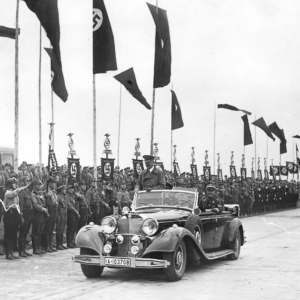
For the government, however, rearmament was the actual goal. In February 1933, the Nazis launched a rearmament programme, and made it look like job creation wherever it was possible. By 1934, military spendinghad already exceeded all spending on civilian job creation.
Rearmament on such a scale had to be financed somehow, and it had to remain mostly hidden from the rest of the world because of the Versailles Treaty. Hjalmar Schacht,head of the Reichsbank from 1933 and economics minister from 1934, was responsible for solving these issues.
He came up with the following scheme: arms producers were paid with IOUs drawn on a shell company, Mefo, so the borrowing did not appear in the state’s official accounts. These were called “Mefo bills”,and by 1938 they added up to 12 billion marks, on top of about 19 billion marks of official debt.
This shows that the government’s part in the recovery was financed by credit, much of which was hidden, and that most of the money went into weapons.
Who bore the costs?
Since the state spent its money on weapons, what did everyday life look like for citizens?
On 2 May 1933, unions were abolished and their assets seized. They were replaced by the German Labour Front, and Nazi-appointed trustees set the wages. Also, the regime deliberately held back private demand to make room for rearmament, which caused consumer spending to grow more slowly than the economy.
In June 1933, marriage loans were introduced, which offered couples up to 1,000 marks on condition that the wife left her job. This freed up jobs for men and lowered the unemployment figures by excluding women.
The heaviest costs, however, fell on Jewish Germans. The Nazi government pushed Jewish business owners, who already faced discrimination, to sell at reduced prices. By 1938, two-thirds of the roughly 100,000 Jewish businesses that existed in 1933 had closed or been sold to non-Jews.
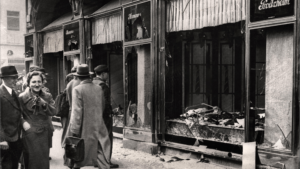
Kristallnacht – a nationwide pogrom on the night of 9–10 November 1938 – was the final blow to Jewish businesses. Afterwards, all remaining Jewish operations were forcibly transferred to non-Jews. On top of that, a fine of one billion marks was imposed on the Jewish population.
The unevenly shared gains, and the fact that the costs were forced on those who could not fight with the regime – workers, women and, above all, Jewish Germans – show that the recovery came at a heavy price: oppression and discrimination.
What were the aims?
In 1936, Hitler set out the Four Year Plan, the main aim of which was to make Germany self-sufficient and ready for war. Specifically, he wanted to prepare the armed forces and the economy for war within four years. Hermann Göring was put in charge of the plan.
But even the economics minister Hjalmar Schacht did not believe such a pace could last.
He objected to the continued high military spending, fearing that it would cause inflation, and left the ministry in November 1937.
In January 1939, he was dismissed by Hitler as head of the Reichsbank, after arguing for cuts in arms spending to prevent inflation.
When war started in 1939, Germany could not supply everything its economy needed, so a significant part of its resources came from plundering the occupied territories. Furthermore, Germany benefited from forced labour: in August 1944 there were approximately 7.6 million foreign workers and prisoners of war in Germany, mostly from the Soviet Union, Poland and France.
Harbingers’ Weekly Brief
Subscribe to the Harbingers’ Weekly Brief, a newsletter written by the editorial board of Harbingers’ Magazine, the world’s youngest newsroom, delivered to your inbox every Monday morning.
![author_bio]()


An economic miracle?
The government’s part in the recovery was paid for with debt, much of it hidden. The costs fell on ordinary people – workers, women and Jewish Germans. And the aim of all this was war, during which the economy ran on plunder and forced labour.
Much of the so-called miracle, however, was propaganda: Hitler took credit for inherited schemes and for the first motorway. The Autobahn was a showpiece, but it employed few people. Rearmament was portrayed as job creation, while unemployment figures were lowered by excluding women.
The turnaround was real, but it was not a miracle. It was a rearmament boom paid for by oppression and plunder.

© 2026 The Oxford School for the Future