


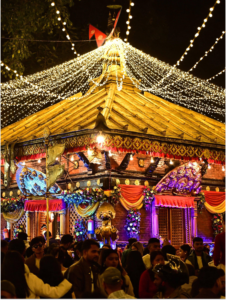
15-year-old Rakshya from the Nepali Newsroom explains what happens during Nepal’s most important Hindu festival
Almost every Nepali looks forward to Dashain, a joyous festival when they spend time with family and loved ones. Held every year, it is considered one of the greatest Hindu festivals.
Dashain, also known as Durga Puja or Navaratri, celebrates the victory of the goddess Durga over the demon Mahishasura, which symbolises the victory of good over evil. It is usually celebrated in October or November (Ashoj and Kartik in the Nepali calendar) and is a major event in Nepal and northern parts of India that have strong Nepali connections.
The festival lasts for 15 days. On the first day, known as Ghatasthapana, people sow barley seeds and place them in a dark room. The seedlings are called jamara (‘green leaves’) in the Nepali language. There is a belief that jamara dispels negative energy in the home. “Jamara brings positive energy and vibe in the family,” said Gyani Shah, an English teacher in a Kathmandu school.
Harbingers’ Weekly Brief
Subscribe to the Harbingers’ Weekly Brief, a newsletter written by the editorial board of Harbingers’ Magazine, the world’s youngest newsroom, delivered to your inbox every Monday morning.
![slide image]()
![author_bio]()
![author_bio]()


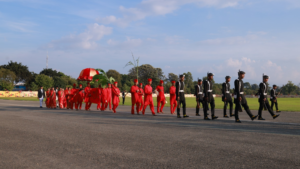
The next most important day is the seventh day, known as Fulpati, which refers to the nine sacred plants given in offerings on this day. The main celebrations are held in Kathmandu, where the Nepali army brings Fulpati from Gorkha Durbar to Hanuman Dhoka Gate. People also go to the forest to search for fresh bamboo poles to make traditional swings (ping in Nepali).
Schools are closed for the duration of the whole festival, while government offices are closed from Fulpati.
The eighth day is called Maha Astami and the ninth Maha Nawami. On the eighth day, people sacrifice animals such as goats, buffalo, hens, pigeons and sheep while on the ninth day people worship their tools, vehicles and weapons as a display of gratitude towards livelihoods and protection.
The tenth day – Bijaya Dashami – is the most important day of Dashain. People dress up in new and attractive clothes. Elderly people give blessings to younger family members. They put red tika on their foreheads and place jamara on their head. People eat delicious food and fruit.
The final day of Dashain is Kojagrat Purnima. On this day, people light auspicious lights (Mahadeep Jyoti) at night when the full moon rises. The jamaras are then disposed of in a river.
What people think
Santu Lama, a school teacher in Kathmandu, says that Dashain spreads love, happiness, spirituality, kindness and blessings to all.
It also reminds us to do good deeds, she says. It brings family members together, at least for a few days. It teaches us that we get happiness in sharing and caring, and inspires us to be involved in good activities.
Dawa Sherpa, who works in the tourism industry, came home from Austria so that he could spend Dashain with his family in Nepal. “I choose to work only during the [tourist] season, so that I can come to Nepal during festival time and Nepali new year,” he said. “Dashain is the best festival that brings everyone together.”
View this post on Instagram
Pema Yangi Sherpa, 14, told Harbingers’ that Dashain means getting a long holiday from school, meeting relatives and friends, eating good food and enjoying time with family.
To 14-year-old Simran Tamang, Dashain means wearing new clothes, eating delicious food, receiving tika and blessings, playing with cousins and enjoying happy moments with her family.
Karma Tamang said that Dashain means respecting our culture and traditions, worshiping the goddess Durga, meeting family members and giving blessings to the younger generation. Nisha Tamang, who comes from the same village, agrees that Dashain brings family members together.

Edited by:
© 2026 The Oxford School for the Future