Harbingers’ Magazine is a weekly online current affairs magazine written and edited by teenagers worldwide.
harbinger | noun
har·bin·ger | \ˈhär-bən-jər\
1. one that initiates a major change: a person or thing that originates or helps open up a new activity, method, or technology; pioneer.
2. something that foreshadows a future event : something that gives an anticipatory sign of what is to come.
We and our partners may store and access personal data such as cookies, device identifiers or other similar technologies on your device and process such data to personalise content and ads, provide social media features and analyse our traffic.
Have you ever felt grateful that AI (artificial intelligence) just saved you from spending hours on your maths homework? Or have you ever felt like AI is going to take over and destroy our world?
If you have felt either, or likely both, The AI Doc: Or How I Became an Apocaloptimist is the reality check you didn’t know you needed.
Co-directed by Americans Daniel Roher and Charlie Tyrell, the film was released on 27 March and is currently available on various streaming platforms (depending on where you live).
Hoping to find out more about AI, Roher – soon to be a father – dives into an eye-opening journey about this new powerful technology and most importantly… what’s at stake if it all goes wrong?
The term apocaloptimist, a mashup of the words apocalyptist and optimist, accurately captures the documentary’s contradictory tensions. Instead of choosing between blind optimism or outright fear, the film lies in the middle, amid the chaos.
Fortunately, The AI Doc doesn’t drown you in technical jargon, but keeps things relatively simple. It explains the big ideas, like what AI is, how AI learns, why it is advancing so fast and why everyone is suddenly involved, while coming back to the question: what does this mean for the future of the human race?
There is no doubt that question is overwhelming, so the film uses humour and personal reflection instead of pretending to know it all.
As you get deeper into the film, it feels more like a friend trying to navigate the world alongside you.
Roher is an artist, so he also adds animated graphics and hand-drawn elements that brings his commentary to life. These tiny details transport the viewers into the mind of a curious child, making a heavy topic feel lighter and more digestible.
Roher interviews about 40 experts in three distinct categories, as follows:
Apocalyptists
The apocalyptists, or so-called “techno-doomers”, present their dark and pessimistic views first. One of the interviewees, American AI researcher and computer scientist Eliezer Yudkowsky, even calls himself “the original doom guy”.
They claim that we are only at the start of a treacherous battle with technology; some even say that their children won’t survive to make it to high school. It sets an unsettling tone, making viewers think of the worst-case scenarios and the extreme possibilities of AI.
Optimists
In contrast, the optimists offer a beacon of hope. While the apocalyptists claim that AI is going to end civilization before we can respond, the optimists claim that the human race needs assistance from AI to survive.
They talk about AI’s potential to predict weather more accurately, to help protect humans from natural disasters, create cognitive development tools, and improve affordable education. They challenge viewers to not think of AI as a threat, but as a friend to tackle global issues.
Lastly, the documentary turns towards those who own the technology. While big names such as Elon Musk and Mark Zuckerberg declined, Roher managed to get three AI company chief executives to participate: Sam Altman from OpenAI, Dario Amodei from Anthropic, and Demis Hassabis from Google DeepMind.
All of them addressed concerns around AI, then quickly reassured viewers that their company is more ethical than the rest, and they are rushing to increase safety and environmental measures. Their comments introduce scepticism, leaving viewers to wonder how much trust they should be putting in AI in the future.
Is The AI Doc worth watching? Yes. The creative, animated graphics, direct information from big names in the AI industry through interviews, and personal narrative makes the film engaging.
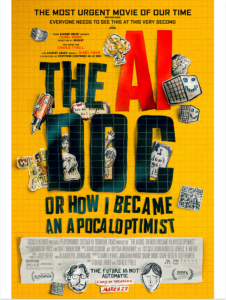
Poster for ‘The AI Doc’.
Roher, who began his journey trying to find comfort amid the mania over AI, experienced many different viewpoints, but did not find one clear conclusion. Similarly, as viewers we also walk away without a solid answer.
This is why I give The AI Doc a four-star rating. Even though I learned so much about AI over the course of one and three-quarter hours, I still have the same anxiety about it. I simply became more knowledgeable about the topic, increasing my awareness about its complexities and potential risks.
The film lacked an overall solution, which is why I didn’t give it a full five stars. However, you could argue that ambiguity is the point of the documentary. Maybe that’s what an “apocaloptimist” really means: learning to live with both fear and hope.
So if you are searching for answers, you will not find them in The AI Doc. But in order to better face our future, this film is definitely worth watching.
Jennifer Yung-Coak, born in 2009 in Hong Kong, studies in New Hampshire, United States. She joined Harbingers’ Magazine in August 2025 as part of the Japan Newsroom programme, where she began contributing articles to the magazine.
Since then, she has written on topics including architecture, international relations and human rights, while also bringing her enthusiasm for athletics to the newsroom. Her consistent work and dedication to the magazine led to her appointment as Sport Section Editor for 2026.
Jennifer is interested in design, business and economics, and plans to continue her studies at an American university.
In her free time, she enjoys travelling, drawing and playing sports, and also takes part in volunteer programmes working with children.
🌍 Join the World's Youngest Newsroom—Create a Free Account
Sign up to save your favourite articles, get personalised recommendations, and stay informed about stories that Gen Z worldwide actually care about. Plus, subscribe to our newsletter for the latest stories delivered straight to your inbox. 📲
We use cookies to ensure that we give you the best experience on our website. If you continue to use this site we will assume that you are happy with it.