

17-year-old Mutaz explores the history and diversity of traditional Arab men’s attire
When people picture the Arab world (roughly, the 22 states that make up the Arab League), they often imagine men riding camels through the desert wearing white robes and red and white headscarves. While there is some truth to this image, it is about as accurate as saying every man in London wears a bowler hat and drinks tea.
In reality, traditional Arab clothing comes in many forms; from the tailored collars of Jeddah (Saudi Arabia) to the uncuffed sleeves of Cairo (Egypt), each garment reflects the history, culture and traditions of its region.
Traditional clothing is prevalent in Arab countries, but so is modern clothing. Traditional garments can even be worn with modern items in some instances – wearing a keffiyeh at graduations, or sneakers with thobes. Modern tuxedos go well with any fez.
This piece explores some of the most well-known items of traditional Arab men’s clothing, how they differ across the Arab world and how they are worn.
View this post on Instagram
Keffiyeh
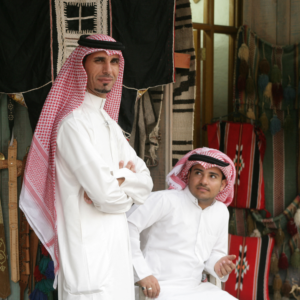
Perhaps the most famous piece of Arab clothing, the keffiyeh is a square cotton headscarf with a black cord called an iqal. A small cap, known as a taqiyah, is often worn underneath for stability. In the Gulf, the keffiyeh is commonly known as a shemagh.
Keffiyehs come in different patterns and colours. Red and white designs are common in Saudi Arabia and Jordan, while the black and white versions are closely associated with Palestine and other parts of the Levant (the region of West Asia along the Mediterranean). White styles are widely worn across the Gulf.
Elsewhere, headwear worn alongside the keffiyeh may include turbans, round and square caps, and the fez (or tarboosh), depending on local traditions.
In formal settings, the keffiyeh is traditionally worn with a thobe rather than casual clothing.
Here is a quick tutorial on how to wear the keffiyeh in one of the many styles it can be worn.
- Fold the square keffiyeh diagonally in half to create a large triangle.
- Before putting it over your taqiyah, make a small, 5–8 cm fold along the long, straight edge. This creates the clean, raised rim you see under the iqal.
- Place the keffiyeh on your head, ensuring the two long tails hang evenly on both sides.
- Place the iqal firmly over the top of your head to clamp the fabric down.
- Let the two long ends drape casually over the front of your chest and shoulders, like a loose frame.
Thobe
The thobe (or galabiya, djellaba, dishdasha, kandura and jubba) is a loose, ankle-length garment worn across much of the Arab world.
Styles vary by region. In the Gulf and the Levant, thobes traditionally feature collars and fitted sleeves, while Egypt and Sudan favour the collarless galabiya with a looser
In Morocco, some versions also include a hood.
Most thobes are worn over loose, lightweight trousers called sirwal. In some coastal parts of the Gulf and Yemen, some men wear an izaar, a wrapped garment similar to the lungi, kikoy and sarong of neighbouring cultures.
Climate also plays a major role in shaping traditional Arab clothing. White thobes are popular in hot weather because they reflect sunlight and help to keep the wearer cool.
During colder months, thicker fabrics and darker colours become common. In some colder regions, men wear farwa, a heavy, fur-lined cloak with a hood.
Harbingers’ Weekly Brief
Subscribe to the Harbingers’ Weekly Brief, a newsletter written by the editorial board of Harbingers’ Magazine, the world’s youngest newsroom, delivered to your inbox every Monday morning.
![author_bio]()
![author_bio]()


Bisht
Often associated with status and ceremony, the bisht is a long, open robe usually decorated with gold trim. Available in numerous colours (black, brown, grey, white, yellow, sometimes blue or green), it is traditionally worn at weddings, celebrations and formal events. It is also worn on a daily basis by royalty, tribal elders and other prominent figures.
Footwear
Traditional footwear varies widely. In North Africa, men wear the balgha, a slipper-like, open-heel leather shoe available in different colours and designs. In Sudan, the markoob is more common. Usually made from animal hide, it has a enclosed heel and varies from region to region.
Sandals also remain popular across much of the Arab world. In the Gulf, the madas sharqi is a well-known example, valued for its practicality in hot climates.

Edited by:

© 2026 The Oxford School for the Future