



Harbingers’ editors look back on their experiences during a year of global tensions, and give advice to future editors
‘The diversity of this community is what makes it so special.’
27 February 2026
Easier said than done: The 2025 Editorial Board reflects on the past year
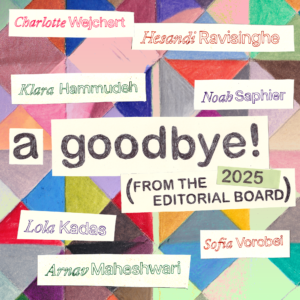
In the beginning of March every year, Harbingers’ Magazine changes its Editorial Board. The editors for 2025 were Noah Saphier, Klara Hammudeh, Lola Kadas, Arnav Maheshwari, Hesandi Ravisinghe, Sofia Vorobei and Charlotte Wejchert.
It was not an easy task to keep up with the many events that marked 2025 and the first months of 2026. We reported on ongoing conflicts in the Middle East; political tension in Southeast Asia; worldwide Gen Z-led protests; the sophistication of AI; the shift to right-wing politicians in general elections; and the rise of anti-immigration rhetoric in the West – to name just a few topics.
Here, we all reflect on our roles and accomplishments in a challenging time as we tried to follow the news cycle. We’ve also got some great advice for future editors!
Harbingers’ Weekly Brief
Subscribe to the Harbingers’ Weekly Brief, a newsletter written by the editorial board of Harbingers’ Magazine, the world’s youngest newsroom, delivered to your inbox every Monday morning.
![author_bio]()
![author_bio]()
![author_bio]()
![author_bio]()
![author_bio]()
![author_bio]()
![author_bio]()

Noah Saphier
Editor-in-Chief | 18
This year has marked my third year as a writer for Harbingers’ Magazine and my first year as editor. As Editor-in-Chief, my job, in addition to writing and editing pieces, was to oversee everything. This means managing the editing process from the start, by assigning pieces to editors, to tracking the progress of pieces until they are published.
Every Sunday, I wrote to the publishing team to let them know which pieces were ready for the website in the upcoming week. Additionally, I set up and ran meetings with the rest of the editorial board, where we discussed the magazine’s content and also wrote editorial pieces – such as this.

Meeting and working with the Harbingers’ team, with members from all over the world, was the thing I most enjoyed about being Editor-in-Chief.
I am most proud to have instigated the four editorial pieces that Harbingers’ published, covering our thoughts on AI,our analysis of the history of Pride Monthand its current relevance; the complicated balance between being young and using social media;and this farewell piece.
Having written articles mostly on my own for my first two years, I cherished being able to work with other people, using these editorial pieces to learn how to find communalities and contrasting ideas to piece together all our seven viewpoints. I hope that the new rotation of editors in 2026 continue to collaborate on more editorials.
As team lead, there is a lot to do and a lot of interesting people to talk to, making my year busy but exciting! The challenges I faced came with learning how to juggle the many responsibilities that come with being Editor-in-Chief, including the many weekly meetings I attended and ran with people in different time zones, the publishing list I sent out every Sunday, the pitches I assigned to editors, all while continuing with my own editing and writing.
I feel that this experience has helped me to develop strong skills in time management and organisation that will help me with whatever future endeavours I undertake.
My advice to future editors is, take your tasks one step at a time to avoid getting overwhelmed; utilise a calendar to help organise your responsibilities; and be in constant communication with the other team members and mentors from the Harbingers’ Project.
Lola Kadas
Society Section Editor | 17
During the last year that I’ve been editing the Society section – our writers’ favourite – I’ve loved more than anything being able to learn about so many different topics that I wouldn’t otherwise have discovered. From Gen Z protests to matcha, mental health and social media trends, this experience has been so fulfilling.
It is not only facts that I’ve learnt about, though. I also kept on top of emails and managed my inbox much more regularly, which is something I find essential for not only Harbingers’, but other projects and my schoolwork too.
In terms of writing, a very specific aspect that editing has helped me with is the increased intention with which I now write. I pay much more attention to the lengths of my sentences, and use links that provide evidence for the exact point I am trying to make.

One of my favourite articles that I edited this year was Reva Sobti’s Letter to a fellow soul-sucked-by-exams student.It explored the struggle of exam season while giving a necessary and motivating message that soon it will be over and our efforts will pay off. I related to this piece very much and found comfort in the reminder that so many others are having a similar experience.
A challenge that I’ve overcome through practice has been giving feedback. While editing a piece, it is really important for me to not voice feedback or ask questions in a way that makes me seem ‘superior’ to the writer. Similarly, it was at times difficult to keep the original voice of the writer while editing, especially when it was an opinion piece.
Stemming from these challenges, I have assorted advice for future editors. First, check your emails frequently. You don’t want to miss any important pitches, meeting dates or editorial project threads!
Next, I think it is paramount to remember while editing that you should change as little as possible so as to keep the original thoughts of the writer, especially when it comes to opinions or personal experiences.
The combination of both of these would be to keep in touch often with writers while exchanging constructive feedback or questions. And most of all, enjoy the process!
Arnav Maheshwari
Economics Section Editor | 17
This year as Economics section editor has been one of the most intellectually demanding and rewarding experiences I’ve had. Stepping into the role relatively soon after joining the magazine as a Harbinger Prize winner in 2024 was both exciting and challenging. It required me to learn quickly and adapt fast, a responsibility that shaped much of my growth this year.
Economics often sits beneath the surface of global events, but editing this section made me realise how central it is to understanding conflict, elections, trade, technological change and even culture.

But how do you explain inflation without reducing it to a buzzword? How do you write about trade or defence spending without losing the reader in statistics? How do you preserve nuance while still being clear? Editing the section pushed me to wrestle with these questions constantly.
Interestingly, my favourite piece to edit this year was not strictly an economics article. Charlotte Wejchert’s AI won’t replace you – it’ll be your teammatestood out because it explored the evolving relationship between technology and human capability in a thoughtful, balanced way.
It captured the tension between fear and opportunity that defines much of Gen Z’s discussion around AI, while serving as a helpful reminder that progress does not wait – we must learn to adapt and evolve alongside it.
The biggest challenge I faced was fact-checking – both in my own writing and in the pieces I edited. Economics leaves very little room for approximation; numbers either hold up or they don’t. Oftentimes, a single outdated statistic or misinterpreted figure can quietly unravel an otherwise strong argument.
I grew far more confident in that process as the year progressed, but there is always room to sharpen that discipline – and I hope to continue refining it in another year at Harbingers’.
Undoubtedly, my biggest advice to future editors is to nurture the relationships you build at Harbingers’. From mentors and publishers to writers and editors across different countries and cultures, the diversity of this community is what makes it so special. These are the bonds you carry with you beyond the year – and, for me, they have been the greatest asset of this experience.
Hesandi Ravisinghe
Science Section and Nepali Newsroom Editor | 16
I can’t believe a whole year has passed already. It has been a delight to be the editor of the Science section and the Nepali Newsroom. I’ve learned so much about the world and about editing pieces. Being an editor really helped me improve my own writing skills and also explore topics that are new to me.
I particularly enjoyed editing articles from the Nepali Newsroom and learning about the country’s culture. I’m very proud of how far these young writers have come and how much they have improved in such a short time.

I think the biggest challenge for me was to maintain the writer’s voice while still correcting mistakes. I also enjoyed the articles I edited from the Sciencesection, even though it’s one of the least popular sections among our writers – which I hope changes soon!
One of my favourite articles, which I remember vividly, is The paradox of time: too much or too little?by Elias Malmqvist. It was one of the first articles I edited, and I had never seen anyone explore a similar concept before. It was truly amazing advice, and I’d recommend it to anyone reading this.
To future editors, my biggest piece of advice is to always imagine yourself in the writer’s shoes: it’s important to understand what their message is before you think about what needs to change.
Sofia Vorobei
Culture Section and Afghanistan Newsroom Editor | 16
It’s already been a year, but, honestly, it feels like much less. Being one of Harbingers’ Magazine editors has been an amazing experience. I’ve come to understand the editing and publishing process better, and I’ve learned to handle responsibility more confidently.
Taking care of the Culture section has been one of my favourite parts. I’ve loved reading and editing other people’s opinions on things I genuinely care about, such as cinema. I’ve discovered films and TV shows I’d never heard of and added them to my watchlist – it felt like getting recommendations straight from the writers.
Editing the Afghanistan Newsroom pieces was also very interesting. I got to learn a lot about the situation in the country and all the struggles people go through there.
The biggest challenge was correcting pieces critically and leaving comments. At the beginning, it made me uncomfortable to ‘judge’ something that someone else had put time and effort into creating. I didn’t feel that I was entitled to ‘correct’ other people’s work – writing is a creative process, after all, and sometimes the imperfections are part of what makes it what it is.

Well, that was the mess going on in my head when I started editing. With time, however, I realised that editing doesn’t mean any of that and simply consists of polishing the pieces slightly.
The article I most enjoyed editing is ‘I get to live a thousand lives’: Young actors speak outby Anastasia Kulikova. I liked it so much because it’s a reminder that acting isn’t just about Hollywood. There are actors out there who simply love what they do and manage to make a living from it, even if they’re not big names.
That’s something aspiring actors really need to hear – their path isn’t impossibly narrow or unrealistic. Anastasia interviewed actors who talk honestly about their struggles and their good experiences, and that’s why it’s my favourite. It offers a genuine glimpse into the craft and shows what it’s like beyond the A-list.
Finally, here is my advice to future editors. Read the whole piece before starting to change anything and try to fully understand it. It makes it a lot easier to work with it later.
Charlotte Wejchert
Human Rights Section and Armenian Newsroom Editor | 17
Being an editor has taught me many things over the last year. One of the most interesting skills that I have discovered is the ability to engage deeply with the writers’ voices in a way that any amendments that I make are consistent with their tone and register.
Moreover, reading a piece closely multiple times also makes me feel very connected to the person that wrote it – so much so that I imagine what their voice sounds like, even though, in most cases, I never get to meet them.
From a more tangible point of view, editing articles related to human rights has deepened my knowledge of crises and regions that I knew about and also exposed me to completely new topics and situations that I wasn’t aware of.

I also had the great privilege of being the editor for the Armenian Newsroom.I really enjoyed editing pieces from Armenia, and I feel that I became quite informed on the geopolitical situation. As the country was dealing with war and receiving a mass exodus of refugees from Nagorno-Karabakh, I developed a personal understanding of their situation since my very first piecewas the result of a trip to Yerevan, where I actually met and interviewed the first cohort of the Armenian Newsroom.
I particularly enjoyed editing features centred on individual stories, which made issues feel real and tangible rather than abstract. Harbingers’ is a platform that strengthens this sense of community and has a meaningful impact on young people.
The greatest challenge was balancing critique with encouragement. Effective editing demands assertiveness, but it must remain constructive. The most relevant piece of advice I can offer is, simply to trust your gut; if something doesn’t sit right, do take time to conduct additional research, and ask the questions to get your answers.



© 2026 The Oxford School for the Future