



17-year-old Lisindi reveals how China’s underwater explorations could help its space programme
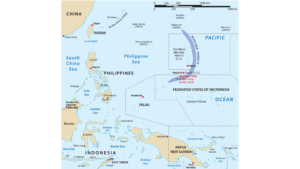
Far beneath the surface of the western Pacific Ocean, south of Japan and east of the Philippines archipelago, lies the deepest known point on Earth: the Mariana Trench.
This underwater chasm is nearly 11 km deep – around two kilometres deeper than Mount Everest is tall – 69 km wide and extends for 2,540 km. The nearest land is the Mariana Islands, 200 km to the west.
Down here, the pressure is crushing – just imagine having an elephant pressing on your fingertip and that same force exerted on your entire body. Moreover, the Mariana Trench is an icy, pitch-black world unlike anything on the surface. It’s a place where light never reaches, temperatures hover just above freezing, and the weight of the ocean above is almost unimaginable.
Since the first descent by Swiss-American explorers in 1960, the trench has drawn the attention of scientists worldwide. But in recent years, no country has pursued its secrets more eagerly than China as it would be “the perfect playground” for their future ambitions in space-related research. Its rapid expansion in exploration efforts in the trench have sparked questions worldwide.
China’s deep-sea dragon
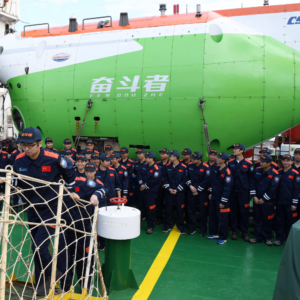
In 2020, China launched Fendouzhe (which means “striver” in Mandarin), a Chinese-made submersible designed for full-ocean-depth exploration. It became widely known for diving to 10,909 m in the Mariana Trench, breaking China’s own previous record and marking one of the deepest ever manned dives.

The Fendouzhe was initially used by the Chinese government to conduct standardised sea trials and collect biological and geological samples. Even in a short amount of time, the discoverieswere astounding.
First, microbial diversity: 7,564 microbial species were identified, of which nearly 90% were previously unknown. These microbes survive under extreme pressure, freezing temperatures and darkness – making the Mariana Trench seem like something out of a sci-fi movie.
The biodiversity in the trench shows unique adaptations to pressure resistance, and many organisms can generate a lot of energy from very small amounts of food.
Chinese scientists believe they can make use of these traits for biotech industrial purposes, such as deep-sea mining or high-pressure chemical reactions; better organ preservation during space travel (where cells are exposed to radiation and extremely cold temperatures); and to design low-energy biofactories.
Xu Xun, a researcher involved in the Mariana Trench studies, has suggested these findings could help scientists understand how alien life might survive in harsh extraterrestrial conditions.
Resources for car manufacturing
The trench also contains large deposits of minerals, metals and rare earth elements. Many of its polymetallic nodules – particularly manganese, nickel, and cobalt – have higher metal concentrations than land-based deposits, making them particularly valuable. These materials are the foundation of modern technologies, especially electric vehicle batteries, which are critical for large car brands in China such as BYD, Changan and Geely.
However, global experts have argued against China’s use of these resources. Deep sea mining risks permanently damaging the trench’s ecosystem, which may take millions of years to recover – if recovery is possible at all.
Moreover, deep-sea mining can release heavy metals and toxic gases such as mercury and ammonia on to the land, and create large clouds on the sea floor that cover vast distances and harm organisms.
For these reasons, the Chinese government is still finding methods to extract all these materials without harming the trench.
Deep-sea space station
China has also proposed building a “deep-sea space station” – a permanent underwater base for long-term research – 1,800 metres below the surface of the South China Sea. It would be able to accommodate six scientists for a month at a time, who would be able to live and work underwater.
The facility would be used for monitoring volcanic activity and cold seeps, study deep-sea organisms for space biology research, and to act as a training ground for astronauts in high-pressure environments. It is expected to be completed by 2030.
American researchers first discovered cold seeps in the Gulf of Mexico in 1984. Fluids rich in chemicals such as methane and hydrogen sulfide escape from crevices in the seafloor, creating unique ecosystems that are not dependent on sunlight. Animals that depend on cold seeps include giant tubeworms and sea cucumbers.
Harbingers’ Weekly Brief
Subscribe to the Harbingers’ Weekly Brief, a newsletter written by the editorial board of Harbingers’ Magazine, the world’s youngest newsroom, delivered to your inbox every Monday morning.
![author_bio]()
![author_bio]()


China isn’t just exploring the Mariana Trench – it’s claiming the underground trench as a lab for future discoveries in space. From discovering foreign microbes to metal nodules that could power the next generation of electric cars, China’s deep-sea missions are bold, risky and revolutionary. But with that ambition comes a massive responsibility.
The Mariana Trench could become the perfect playground for China’s future aspirations in space. However, if innovation is not balanced with protection, humanity risks losing one of Earth’s most mysterious ecosystems before it is fully understood.

Edited by:

© 2026 The Oxford School for the Future