




17-year-old Saanvi explores the benefits – and drawbacks – of digitalised medicine
Saanvi Akula was commended in the Harbinger Prize 2025. This is her entry.
From the moment of waking, there is an instinctual urge to reach out for a device, a response that seemingly feels as if it has been programmed into our systems. One would assume that for a generation raised on screens, sensors and seamless connectivity, there would be nothing that could faze us, but the impact of digital technology has penetrated our very biological rhythms.
The young generations of today are growing into an era where a watch notices an irregular heartbeat before we do. Digitalised medicine is currently growing exponentially and, as with every revolution, it brings both extraordinary promise and profound challenges.
For centuries, medical revolutions have centred around the introduction of new tools: the microscope, the X-ray, the MRI scanner… now, AI is evolving to become medicine’s instrument of precision. Neural networks, trained on vast datasets of medical images and gene sequences, are now detecting subtleties invisible to humans.

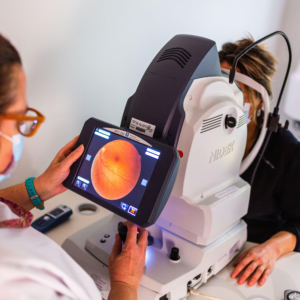
In 2018, Google’s DeepMind developedan AI system that could accurately detect from retinal scans more than 50 eye diseases, including diabetic retinopathyand macular degeneration.
A 2019 cardiology studyfrom Mayo Clinic showed that AI applied to a standard electrocardiogram (ECG – a test that measures the heart’s electrical activity) could predict the presence of asymptomatic ventricular dysfunction – which increases the risk of a heart attack – with an accuracy greater than 85%.
With such accuracy, it’s not surprising that technology is cementing its place in our lives.
Yet dependence on technology has its own pitfalls. Unlike older generations, who might have waited days (or weeks) for a medical appointment in order to get a diagnosis, we can search symptoms immediately online or via social media. One could argue that this democratisation of information helps us stay informed and gives us more autonomy in navigating the way we access healthcare.
But the same technology that promises life-saving insights can also overwhelm us with misinformation. This was very pertinent during the Covid-19 crisis, where false treatments reached millions. A study published in the American Journal of Tropical Medicine & Hygiene estimatedthat nearly 6,000 people were hospitalised during the pandemic due to misinformation, from ingesting methanol to relying on unproven herbal remedies.
Furthermore, the rise of social media and a culture of ‘relatability’ has also led to the normalisation of discussing physical and mental health conditions. This has been great for destigmatising health and bringing awareness. On the flip side, it has led to chronic self-diagnosis. With a quick Google search, seemingly normal symptoms can escalate very quickly, fuelling anxiety rather than alleviating it.
Improving diagnosis
But the effects of technology on our healthcare starts long before diagnosis. Behind every pill bottle now lies not just a lab, but perhaps a server farm. Algorithms can process millions of molecular structures in weeks, something that once took human researchers decades.
For example, in 2022 DeepMind’s AlphaFold solved the 50-year-old “protein folding problem”, predicting the 3D shapes of proteins. This breakthrough has already accelerated research into diseases such as malaria and Parkinson’s. Technology has completely changed scientific timeframes.
If data fuels discovery, diagnosis is where digital tools finally make direct contact with us. Beyond the use of technology in scans, chatbots armed with symptom databases can triage patients before they ever meet a doctor.
Diagnosis used to mean sitting anxiously in a waiting room until a doctor spoke the verdict aloud. For us, it may begin in the glow of a phone screen.
There is reassurance in the precision, but also unease for those dealing with an unfamiliar system.
Care itself has crossed the threshold of geography and time. Telemedicine has allowed a consultation to occur from quite literally anywhere. For those raised on FaceTime and video calls, the experience of seeing a doctor on a laptop no longer feels unnatural. It is an efficient and accessible option, especially for those in remote or underserved areas.
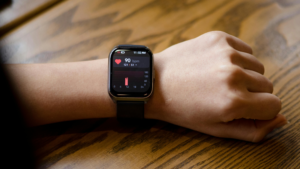
Wearable devices can continuously monitor an individual’s heart rate, glucose levels, sleep patterns and more, alerting patients and doctors to potential issues in real time. Remote monitoring programmes for heart failure patients have shown reductions in hospital re-admissions and improvements in patient outcomes.
Personalised medicine takes this further. A study published in The Lancet in 2021 used machine learning models to predict anti-depressant response in patients with major depressive disorder, showing that tailoring treatment based on patient-specific profiles could improve remission rates.
Harbingers’ Weekly Brief
Subscribe to the Harbingers’ Weekly Brief, a newsletter written by the editorial board of Harbingers’ Magazine, the world’s youngest newsroom, delivered to your inbox every Monday morning.
![slide image]()
![author_bio]()


Dangers of algorithms
However, a screen cannot replicate the reassurance of a hand on a shoulder, a look of understanding or the weight of human presence in a room – and the power of these tools hides fragile fault lines.
Algorithms are only as unbiased as the data they learn from, and history has written prejudice into many datasets. An AI trained predominantly on scans from one demographic may fail to recognise the same condition in another.
In fact, a study published in Science in 2019 revealed that a widely used health algorithm in US hospitals systematically underestimated the needs of Black patients, reducing their access to critical care. Additionally, the historical lack of research on medication for women puts them at a huge disadvantage, as an algorithm would lack the ability to consider such complexities.
To outsource judgment entirely to such systems risks deepening existing inequalities in healthcare. Over-reliance is another danger; doctors may defer too readily to the machine, silencing their own clinical instincts.
Beneath all this lies the question of data privacy. We are so casual about surrendering personal data – heart rates, sleep cycles, even reproductive health records – but such data is currency in corporate and governmental markets. The price of convenience, we may discover, is control.
Beyond healthcare, digital tools reshape how we learn, connect and empathise. Online platforms encourage collaborative learning and information sharing. Virtual communities that support mental health allow for a more connected society. Our relationship with machines has become symbiotic: they expand our abilities and help us live more comfortably.
For a generation raised breathing ones and zeroes, the challenge is to embrace these advancements while guiding them wisely. Technology has given us extraordinary power over our health, and the possibilities are endless. If we pair innovation with empathy, we can ensure that digital tools do not replace human connection, but enhance it for the better.

© 2026 The Oxford School for the Future