







17-year-old Klara picks her favourite articles from the Politics section this year
This year in politics has largely been dominated by the Donald J. Trump and the wars in the Middle East and Ukraine.
While revising the Politics section’s work over the last year, I noticed how successful Harbingers’ writers have been in keeping distance from unimportant, short-lived feuds between politicians.
Instead of describing antagonising events, we managed to keep our focus on the big picture and explain the processes that have a genuine impact on the global political landscape.
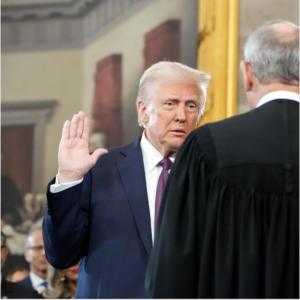
Three months after Donald J. Trump was sworn in as the 47th President of the United States and started a massive offensive on all political fronts, Harbingers’ Lola Kadas shared how his presidency put in doubt whether she would like to live in America. Lola, herself a first-generation American with immigrant parents from Hungary, shared her concerns about women rights, attacks on immigrants and Elon Musk’s appointment as a senior government official (Musk later quit Trump’s administration).
“Overall, Trump’s new administration has left me – and many other young teens – feeling anxious about the future. I am disappointed that somewhere that has served as a place where I thought my dreams and goals would be fulfilled has become a place where there are more individuals discriminated against than not,” Lola argued.
Between the first and the second round of presidential elections in Poland, Prof. Andrzej Leder – philosopher and professor at the Institute of Philosophy and Sociology of the Polish Academy of Sciences – explained in an interview with Harbigers’ Maja Dobrosielska, Pola Gudowicz and Tomasz Morek why right-wing parties continue to gain ground, not just in Poland, but across much of Europe.
In the interview, he traced the shift to a post-communist identity crisis, growing male resentment amid economic and social change, and a broader backlash against women’s emancipation.
On May 18, the right-wing candidate Karol Nawrocki defeated liberal mayor of Warsaw, Rafał Trzaskowski.
“Last November, my family gathered to debrief the shocking results of the US election. Opinions were hurled across the dining tables, uncles and aunts competed to be heard over each other. Amid the personal reality show taking place around my dining table, another question arose in my mind. As the words ‘Kamala’ and ‘Trump’ were tossed around, something irked me. Why was it Kamala vs Trump to begin with?“
In the wake of the US Presidential election, Los Angeles-based Reva Sobti, the winner of The Harbinger Prize 2024, published an fantastic analysis of how differently female and male politicians are treated by the media and the public — a political phenomenon that affects the results of many election rounds.
In August, Harbingers’ assembled in Japan to report from on the 80th anniversary of the atomic bombings of two Japanese cities, that lead to Tokyo’s surrender.
In Hiroshima, Elias Malmqvist, Daniel Zhang, Lukas Abromavicius, Reva Sobti, Jennifer Yung-Coak and me discussed whether the use of atomic bombs was justified, analysed the consequences on people, described the reconstruction effort and the effect the bombings had on attempts to limit the proliferation of nuclear arsenals. As international tensions increase worldwide, also between countries with nuclear capabilities, Japan offered a powerful reminder why should we do everything in our power not to allow another a-bomb to be dropped.
After Hamas attacked Israel on October 7, 2023, killing about 1,200 people and abducting 250 more, Israel launched a military offensive on Gaza. By the end of 2025, up to 80,000 people have lost their lives in Gaza, and throughout the year the situation in the Middle East remained in the focus of media worldwide – from the deteriorating humanitarian situation in Gaza to the risk of full-blown regional war between Israel and Iran.
In August, I argued that while many focus on international pressure on Israel, the key factor for ending the offensive was recognising how the support for the war inside Israel is fading, and rapidly – in early 2025 already the Israel Democracy Institute’s survey found that 72.5% of Israelis said that Netanyahu should resign and take the responsibility for the state’s inability to prevent the October 7 attacks.
In October, an agreement brokered by Donald J. Trump finally achieved a fragile, and frequently violeted ceasefine. In December, Harbingers’ editor-in-chief Noah Saphier published a detailed analysis of the situation in Gaza. He concluded: “To put it simply, what’s next is not clear. Who exactly will fund rebuilding, and what will be the conditions under which countries will be willing to lend money? Doubtless, a ceasefire is a productive first step in the right direction, but the decisions made in the months to come are crucial for the future of Gaza.”